
Power out right now? Start here.
Quick answers
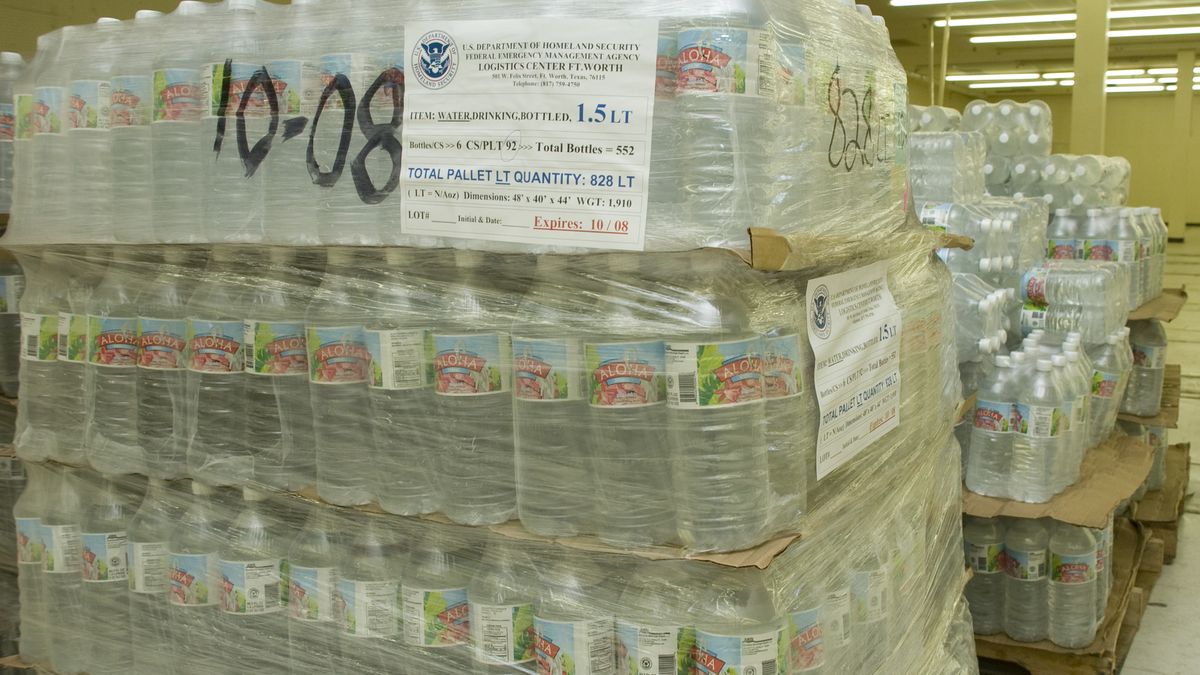
- How much water per person per day? At least 1 gallon, say the CDC and Ready.gov, and more for children, nursing mothers, sick people, pets and hot weather.
- How many days? At least 3, and 2 weeks if you can, says the CDC.
- Best way to store it? Unopened store-bought bottled water, which the CDC calls the safest and most reliable source in an emergency.
- Tap water in plastic bottles? Yes, in clean food-grade plastic with a tight cap, labeled, dated and replaced every 6 months, per the CDC.
- How long does it keep? The CDC and Ready.gov say to replace water you stored yourself every 6 months; several extension services say well-treated water keeps much longer if you check it.
- How to clean a container? Wash, rinse, then slosh with 1 teaspoon of unscented bleach in 1 quart of water, wait 30 seconds, pour it out and let it air dry, per the CDC.
- Where to keep it? Somewhere cool, which the CDC puts at 50 to 70°F, out of sunlight and away from gasoline and pesticides.
- If it runs out? Boil water for 1 full minute, or add a small dose of plain bleach and wait 30 minutes.
How much water to store
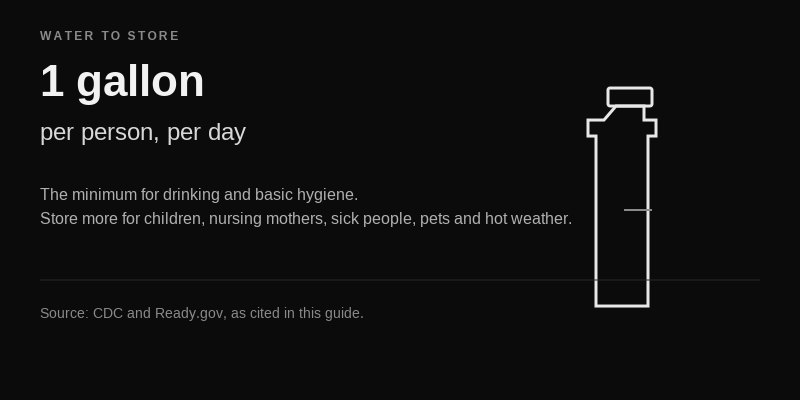
The baseline is 1 gallon per person per day. The CDC, Ready.gov and the University of Nebraska-Lincoln Extension all give that figure, and it covers drinking plus some cooking and washing. For a family of four, that means 4 gallons for every day you plan to cover.
How many days to plan for is where official advice spreads out:
- The CDC says to store water "for 3 days" and to "try to store a 2-week supply if possible."
- Ready.gov says to store it "for several days."
- University of Nebraska-Lincoln Extension says "at least a three-day supply of water for each member of your family."
- Utah State University Extension says "at least a three-day supply is recommended, or up to two weeks if you have adequate storage space."
- University of Missouri Extension says "at least one week's supply."
Three days is the floor nearly everyone agrees on. Two weeks is the CDC's goal, and the one worth working toward if you have room.
Drinking alone takes less than the full gallon, and the agencies phrase it differently. Ready.gov says "a normally active person needs about three quarters of a gallon of fluid daily, from water and other beverages." University of Georgia Extension and Nebraska Extension both say most people need to drink "at least two quarts" a day. Whichever figure you use, the rest of the gallon goes to cooking and hygiene, which is why the CDC and Ready.gov stick with a full gallon for storage.
Plan for more than a gallon in some homes. The CDC names pregnant women, people who are sick, pets and hot climates. Ready.gov names children, nursing mothers and sick people, adds that a medical emergency might need extra, and says "in very hot temperatures, water needs can double." If you live where hurricanes knock out power in summer heat, build that into your count. Our hurricanes page tracks the season.
One more line from Ready.gov is worth keeping in mind: never ration drinking water unless authorities tell you to. Drink what you need today and look for more tomorrow.
Store-bought or fill your own
The CDC says unopened, commercially bottled water "is the safest and most reliable source of water in an emergency." It needs no cleaning or treating, and the CDC asks only that you observe the expiration date on the label. Ready.gov says to keep it in the sealed original container in a cool, dark place.
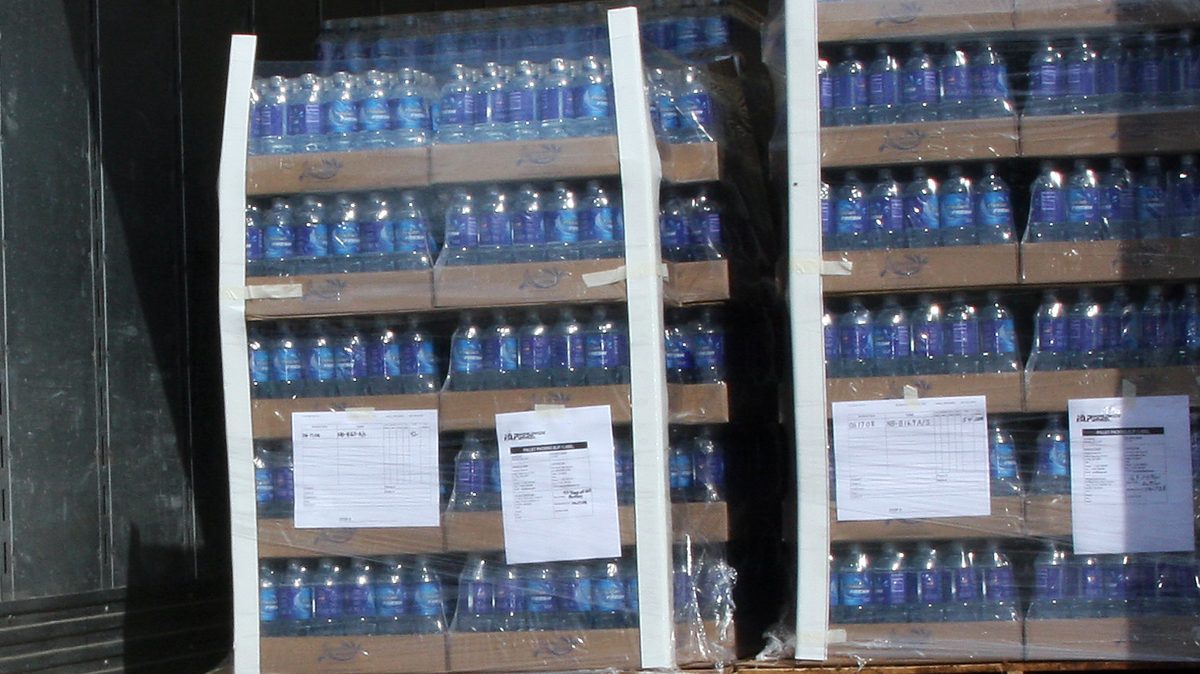
Utah State University Extension sees bottled water a little differently. Its guide calls bottled water "a quick and convenient way to store water" but says it "is not considered to be any safer than water from your tap," since both are regulated, tap water by the EPA and bottled water by the FDA. The two views fit together: tap water is safe going into the container, and the risk comes from a dirty jug or a cap left loose. A sealed bottle skips that risk.
Filling your own costs far less and works well if you clean the containers properly. Most homes can do both: a few cases of bottled water, plus refilled jugs for the bulk of the supply.
Which containers to use and which to avoid
The CDC says the best choice is "FDA-approved food-grade water storage containers," which "will not transfer toxic substances into the water." You can find them at camping and surplus stores, and the CDC suggests contacting the maker if you are not sure a container is food-grade.
If you cannot get a food-grade container, the CDC says to pick one that has a top you can close tightly, is made of durable, unbreakable material (not glass), and has a narrow neck if possible so you can pour from it.
Never reuse a container that held bleach, pesticides or any other chemical. The CDC, University of Georgia and University of Missouri all warn against this. Georgia explains that tiny amounts can stay in the container's pores. Missouri adds a warning about children: a child may not know which bleach bottle holds water and which holds bleach.
The extension services are more open to reused drink bottles than the CDC, and they do not all agree with each other:
- University of Georgia Extension says "intact, durable plastic containers, such as soft drink bottles or those you purchase water in, are best."
- Utah State University Extension says "plastic bottles or jugs previously used for beverages make excellent containers."
- University of Missouri Extension lists "2-liter soda bottles, water, juice, punch or milk jugs."
- University of Nebraska-Lincoln Extension says to "avoid using plastic milk containers if possible, as fat traces may remain," and warns that used beverage jugs "can degrade over time and should not be used repeatedly."
So a clean soda bottle with a tight cap is a reasonable fallback, and a container sold for food or water storage is the safer pick. If you do use a milk jug, Missouri and Nebraska both say to scrub inside the hollow handle.
Two more tips from University of Georgia Extension. Check that lids have no paper liners, and keep containers for personal use to 1 or 2 gallons. Smaller jugs are easier to carry, and if one leaks or gets contaminated you lose less. Georgia says five or ten gallon drums made for water or food work well for larger supplies. Nebraska points out that water weighs over eight pounds per gallon, so check that your shelf can hold the load.
How to clean and fill a container
The CDC's steps:
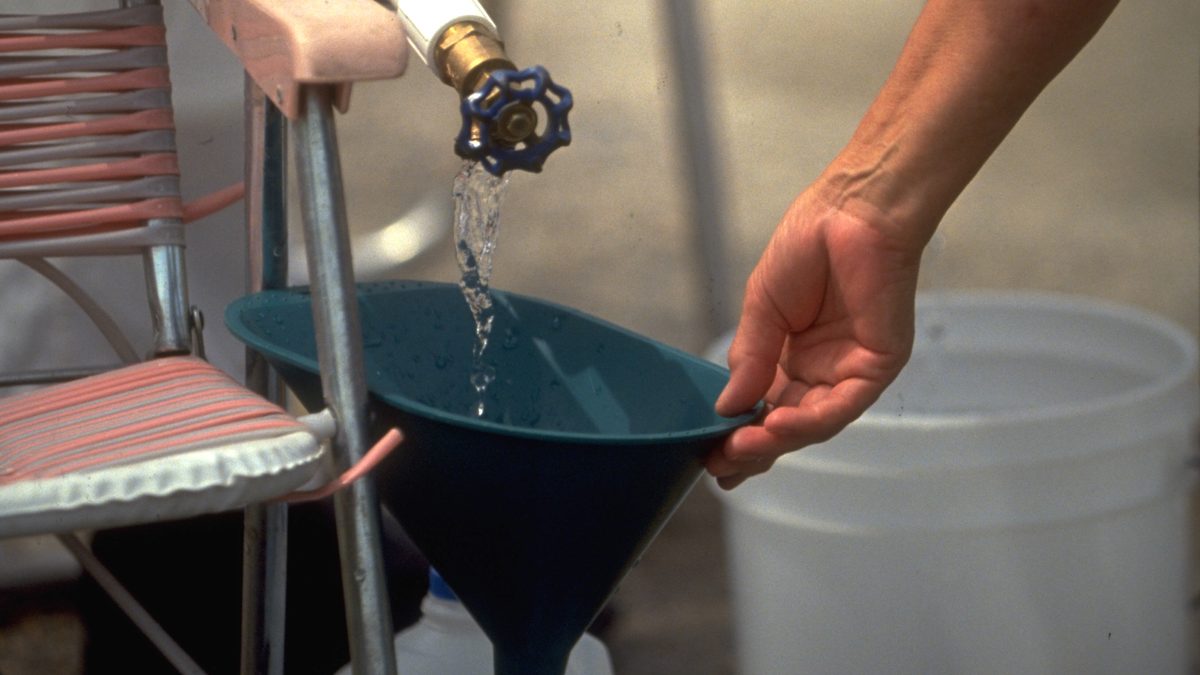
- Wash the container with soap and rinse it completely with water.
- Mix 1 teaspoon of unscented liquid household chlorine bleach into 1 quart (4 cups) of water. The CDC says to use bleach that contains 5% to 9% sodium hypochlorite.
- Pour the mix in, cap the container tightly and shake it well so the solution touches every inside surface.
- Wait at least 30 seconds, then pour the solution out.
- Let the empty container air dry.
- Fill it with clean water and cap it tightly.
Ready.gov gives the same mix: one teaspoon of non-scented liquid household chlorine bleach to a quart of water.
The extension services use other recipes for the sanitizing rinse. Utah State University Extension says to add "1 tablespoon bleach for each 1 gallon of water," shake, turn the bottle upside down to reach the cap, and let it stand for 1 minute. University of Missouri Extension uses "1/2 teaspoon of chlorine bleach per pint of water" and then rinses with clean water. University of Nebraska-Lincoln Extension skips bleach for this step and washes containers with hot tap water and dish detergent, or in a dishwasher. If you are unsure, the CDC's method is the national one and is simple to follow.
Do you need to add bleach to the water you store? The advice splits again. The CDC's storage page has no step for treating clean tap water before storing it. University of Missouri Extension says "it is not necessary to treat water for storage, providing that the water comes from a safe water supply." University of Nebraska-Lincoln Extension says many public supplies already carry enough chlorine, and for water that is not chlorinated, or for an extra margin, adds "six drops of bleach per gallon." University of Georgia Extension says to treat stored water with "four drops of bleach per quart." Utah State University Extension says one gallon "can be treated by the addition of 1/8 teaspoon" of bleach. Missouri and Nebraska both say water from a treated public supply can usually go into storage as is. Well water is a different case: Missouri says water from untested, untreated supplies such as a private well should be purified before storage.
Where to keep it and how long it lasts
Utah State University Extension says to store water "in a clean, dry place off the ground and away from sunlight." Because plastic lets some vapors through, it adds, water in plastic "should not be near gasoline, kerosene, pesticides or similar substances." University of Nebraska-Lincoln Extension says the same about vapors and notes that most plastic drink bottles break down over time, so heat and light speed up leaks. University of Missouri Extension adds, with earthquakes in mind, that shelves and cabinets should not be able to tip over or let containers fall.
The CDC adds the specifics: label each container "drinking water" with the date you filled it, keep it between 50 and 70°F, and keep it out of direct sunlight and away from gasoline and pesticides.
How long that water lasts depends on whose guidance you follow, and they are worth reading side by side:
- University of Georgia Extension: "Water may be stored for long periods of time, such as 5 years or more, if it does not react with the container or [its] components."
- Utah State University Extension: "When potable water (drinkable water) is properly disinfected and stored, it should have an indefinite shelf life. To maintain optimum quality, water should be checked every 6-12 months."
- University of Missouri Extension: water from a safe supply, stored properly, "should have an indefinite shelf life. But you may want to rotate and replace this water every 6-12 months with fresh safe water."
- University of Nebraska-Lincoln Extension: "For best quality, stored water should be used within six months; however, water can be safely stored for longer periods."
- CDC: "If you are filling containers with water to store, replace the water every 6 months."
- Ready.gov: "Water that has not been commercially bottled should be replaced every six months."
The extension services are saying that water itself does not go bad if it went in clean and stays sealed, and that taste and the container are what to watch. The CDC and Ready.gov set a firm 6 month rotation, which is the cautious official rule. The simple path is to follow the 6 month rule, and if you miss a date, check the water rather than assume it is ruined: Utah State says to look for loose lids, cracked containers and cloudiness. For store-bought water, go by the date on the label.
Stored water often tastes flat. Several sources, from Ready.gov to Georgia, Nebraska and Missouri Extension, say to pour it back and forth between two clean containers to put air back in.
Freezing is another option. Utah State and Missouri Extension both say frozen jugs double as storage and help keep food cold if the power goes out. Our guide to how long food lasts in the fridge without power covers how long a closed fridge and freezer stay safe, and what to keep or toss. Leave 2 to 3 inches of headspace for the ice to expand, and Nebraska says to avoid freezing water in glass.
Once a container is open, University of Nebraska-Lincoln Extension says to use it within one or two days, keep it in the fridge at or below 40°F if you have power, and not drink straight from it. The CDC says to use a clean scoop every time and keep your hands out of the water.
If your stored water runs out: making water safe
If you run through your supply, Ready.gov says to treat any water of uncertain quality before you drink it, cook with it, brush your teeth with it or make ice. First let particles settle, or strain the water through coffee filters or layers of clean cloth.
Boiling. Ready.gov calls boiling "the safest method of treating water" and says to hold a rolling boil "for one full minute." The CDC and the EPA agree on 1 minute but add a high-altitude rule, and they draw the line in different places. The CDC says to boil for 3 minutes "at elevations above 6,500 feet," and the EPA says 3 minutes "at altitudes above 5,000 feet." Some extension guides ask for longer at any height. University of Missouri Extension says 3 minutes, Utah State says 5 minutes "for any altitude in Utah," and University of Georgia Extension says 10 minutes. One minute is the federal guidance at lower elevations. If you live high up, use the CDC or EPA altitude rule. If a boil-water notice is in effect, see what to do during a boil water advisory.
Bleach. If you cannot boil, plain unscented bleach kills most germs. The amount depends on the strength printed on the label, and the sources describe that strength differently:
- The CDC says household bleach in the U.S. "will typically be between 5% and 9% sodium hypochlorite."
- Ready.gov says to use bleach "that contains 5.25 to 6.0 percent sodium hypochlorite."
- The EPA says the label "may say that the active ingredient contains 6 or 8.25% of sodium hypochlorite."
- Utah State University Extension says "4 to 6 percent," and University of Nebraska-Lincoln Extension also says 4 to 6 percent.
- University of Georgia Extension says to use bleach that "contains 5.25 percent sodium hypochlorite."
- University of Missouri Extension says bleach that "contains 6.0 percent hypochlorite."
The dose for a gallon of clear water also differs:
- Ready.gov: "Add 1/8 teaspoon of bleach per gallon of water, stir and let stand for 30 minutes."
- CDC, for 5% to 9% bleach: 8 drops per gallon, which it says is "a little less than ⅛ teaspoon," then wait at least 30 minutes.
- EPA: 8 drops of 6% bleach, or 6 drops of 8.25% bleach, per gallon, then 30 minutes.
- University of Missouri Extension: 1/8 teaspoon per gallon of clear water, 1/4 teaspoon if it is cloudy.
- Utah State University Extension: "¼ teaspoon (16 drops) of liquid chlorine bleach per gallon" for clear water.
The safest move is the one the CDC puts first: follow the instructions for disinfecting drinking water on your own bottle's label, if it has them. Without label instructions, the CDC and EPA both say to double the dose for cloudy, colored or very cold water. Ready.gov and the EPA agree on the smell test: after 30 minutes the water should smell slightly of chlorine. If it does not, Ready.gov and the EPA say to repeat the dose and wait 15 more minutes, and Ready.gov says to throw the water out if it still has no chlorine smell.
Bleach weakens as it ages, which matters if a bottle has been sitting in your kit. Utah State says it "can lose up to half its strength after 6 months." Nebraska prefers bleach "not more than three months old." Missouri says to use bleach bought "less than 6 months ago," and the EPA says bleach stored at room temperature for "less than one year." Buy a fresh bottle when you rotate your water.
The CDC notes that chemical disinfectants "do not work as well as boiling" against the parasites Cryptosporidium and Giardia, so boil when you can.
Distillation. Boiling and bleach kill germs but do not remove salts, heavy metals or most chemicals. Ready.gov says distillation removes those as well: hang a cup from the inside of an upturned pot lid, boil the water for 20 minutes, and the water that drips into the cup is distilled. The CDC is clear that water with fuel, toxic chemicals or radioactive material cannot be made safe by boiling or disinfecting. Use bottled water or another source instead.
Water already in your home. The EPA, University of Georgia Extension and University of Missouri Extension all point to your water heater tank, the water in your pipes and ice cubes. Turn off the gas or power to the water heater before you drain it. Georgia calls the toilet tank (never the bowl) a last resort that must be purified first, and Missouri says not to drink tank water if a chemical disinfectant or purifier has been added to it. The CDC says never to use water from radiators or home heating boilers. If a storm is coming fast, Georgia Extension suggests filling large clean containers and bathtubs, so you have water you can treat later. A rigid food-grade can is the container we use as the household-volume pick on our emergency water storage containers page.
Doom Signals earns from qualifying Amazon purchases.
Scepter says this 5-gallon / 20-litre HDPE can provides safe water storage, with a spout that stores inside the can. It is the top pick on our emergency water storage containers page.
Going past 2 weeks
Two weeks of stored water covers most outages and storms. Our power outage kit list covers the rest of a two week home supply, and the winter storm power outage kit walks through the gear that belongs with that water when heat and lights also fail. Longer emergencies take a different plan: larger drums, a way to collect and disinfect rainwater, and a backup for a well pump that runs on electricity. Our comparison of portable power stations and generators covers how to keep a pump running, and the outdoor safety rules. For how far to set a generator from the house, see How Far Should a Generator Be From the House?. Our guide to preparing for 90 days without grid power works through that math, starting from Utah State University Extension's gallon per person per day, which comes to 90 gallons for one adult.
Gear that helps
What to look for: food-grade containers with tight lids, made of durable material that is not glass, ideally with a narrow neck or spout (CDC).
Doom Signals earns from qualifying Amazon purchases.
A 5-gallon food-grade water container
Holds the bulk of a family supply in one place. University of Georgia Extension says five or ten gallon drums made for water or food work well for larger supplies. Pick one the maker sells as food-grade, since the CDC says those will not pass toxic substances into the water.
A 1-gallon food-grade water jug
Easier to lift and pour. University of Georgia Extension recommends containers of 1 or 2 gallons for personal use, so a leak or a dirty jug costs you less of your supply.
Lets you fill the tub when a storm is on the way. University of Georgia Extension suggests filling bathtubs when an emergency arises quickly. Treat that water as you would any water of uncertain quality before drinking it.
Bleach is not on this list because any store carries it. The EPA says to choose a regular, unscented bleach whose label says it is suitable for disinfection and sanitization.
Checked Friday, Nov. 13, 2026, 11:40 PM ET. No prices listed because they change daily.
FAQ
How much water should I store per person per day?
At least 1 gallon per person per day, say the CDC and Ready.gov. Store more for children, nursing mothers, sick people, pets and hot weather.
How many days of water should I keep?
The CDC says at least 3 days, and to try for a 2 week supply. Ready.gov says several days.
What is the best way to store water for emergencies?
The CDC says unopened store-bought bottled water is the safest. If you fill your own, use clean food-grade containers with tight lids.
Can I store tap water in plastic bottles?
Yes. The CDC prefers clean food-grade containers with a tight cap, never one that held chemicals, and says to label the water and replace it every 6 months.
How long can you store emergency water?
Follow the date on store-bought water, and replace water you bottled yourself every 6 months, say the CDC and Ready.gov. Utah State University Extension says properly disinfected water should keep indefinitely if you check it every 6 to 12 months.
How do I clean a water container before filling it?
Wash it with soap and rinse it, then shake it with 1 teaspoon of unscented bleach mixed into 1 quart of water. Wait 30 seconds, pour it out and let it air dry, the CDC says.
Where should I store emergency water?
Somewhere cool and dark, which the CDC puts at 50 to 70°F. Keep it out of sunlight and away from gasoline and pesticides.
How do I make water safe if my stored supply runs out?
Bring it to a rolling boil for 1 full minute, longer at high altitude. If you cannot boil it, Ready.gov says to add 1/8 teaspoon of regular unscented bleach per gallon and wait 30 minutes.
Sources
- CDC, How to Create an Emergency Water Supply, June 27, 2025.
- CDC, How to Make Water Safe in an Emergency, Sept. 19, 2024.
- Ready.gov (FEMA), Water, last updated Feb. 22, 2021.
- U.S. EPA, Emergency Disinfection of Drinking Water, last updated Feb. 24, 2026.
- Utah State University Extension, Storing Water (PDF).
- University of Nebraska-Lincoln Extension, Drinking Water: Storing an Emergency Supply, G1536, revised January 2010.
- University of Georgia Extension, Preparing an Emergency Food Supply: Storing Water Supplies, reviewed 2017.
- University of Missouri Extension, Safe Drinking Water in an Emergency, EMW1026, reviewed July 2025.
All pages checked Friday, Nov. 13, 2026, about 11:35 PM ET. How we pick and check sources: methodology and sources.