
Power out right now? Start here.
Quick answers
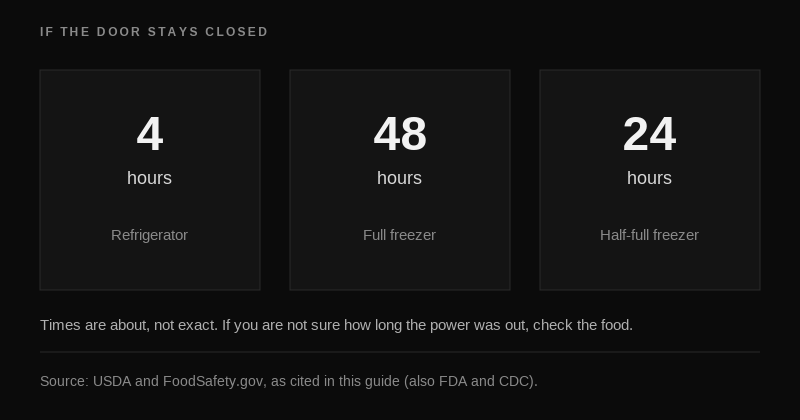
- Fridge without power? About 4 hours with the door closed (USDA, FDA, CDC, FoodSafety.gov).
- Freezer without power? About 48 hours if full, 24 hours if half full, door closed (USDA, FDA, CDC, FoodSafety.gov).
- When to throw food out? Perishables above 40°F for two hours or more (FDA). The USDA and CDC use 4 hours without power.
- Refreeze thawed food? Yes, if it still has ice crystals or is at 40°F or below. Quality may drop (FDA, CDC, FoodSafety.gov).
- Smell or taste test? No. Never taste it. When in doubt, throw it out (USDA, FoodSafety.gov, CDC).
- What usually keeps? Hard cheese, butter, whole fresh fruit and vegetables, unopened juice, bread, ketchup and mustard (USDA).
- Food outside in the snow? No. Freeze jugs of water outside instead (USDA).
- Not sure how long it was out? Check an appliance thermometer. A freezer at 40°F or below can be refrozen (FDA).
The short answer: 4 hours for the fridge, 48 for a full freezer, 24 for a half full one
Every federal agency we checked gives the same 4 hour figure for a closed refrigerator, and the freezer numbers line up too, with one agency leaving out the half full figure. The extension services that study home freezers give a wider range, because a freezer's size, how full it is and what is in it all change how fast it warms. Each source is set out below in its own words.
The fridge:
- USDA Food Safety and Inspection Service (FSIS): "The refrigerator will keep food safe for up to 4 hours."
- FDA, Power Outages: Key Tips: "The refrigerator will keep food cold for about 4 hours if it is unopened."
- CDC: "If the doors stay closed, food will stay safe up to: 4 hours in a refrigerator, 48 hours in a full freezer, 24 hours in a half-full freezer."
- FoodSafety.gov: "your refrigerator will keep food safe for up to 4 hours during a power outage."
- Ready.gov: "The refrigerator will keep food cold for about four hours."
- American Red Cross: "An unopened refrigerator will keep foods cold for about 4 hours."
The freezer:
- USDA FSIS: "A full freezer will hold the temperature for approximately 48 hours (24 hours if it is half full)."
- FDA, Food and Water Safety During Power Outages and Floods: "A full freezer will keep the temperature for approximately 48 hours (24 hours if it is half full) if the door remains closed."
- CDC: 48 hours in a full freezer and 24 hours in a half full one, if the doors stay closed.
- FoodSafety.gov: "A full freezer will hold a safe temperature for approximately 48 hours (24 hours if it is half full and the door remains closed)."
- American Red Cross: "A full freezer will keep the temperature for about 48 hours (24 hours if it is half full) if the door remains closed."
- Ready.gov: "A full freezer will keep the temperature for about 48 hours." Its power outage page gives no half full figure.
- National Center for Home Food Preservation (University of Georgia): "Usually food in a loaded freezer will stay frozen for two to four days, depending on its size. A half-filled freezer will keep food frozen only about 24 hours."
- Oregon State University Extension: in a well-filled freezer, food "will probably not thaw" for 15 to 20 hours "if the door is kept closed." Oregon State's guide was first published in 2013 and reviewed in 2024.
The Oregon State figure is the outlier, much shorter than the 48 hours the federal agencies give. If your freezer is small, old or only partly full, plan on the shorter end and check the food rather than counting on two days.
What to do the moment the power goes out
Keep the fridge and freezer doors shut. Every agency above says this first, because each opening lets cold air out. The USDA adds that grouping food together in the fridge and freezer helps it stay cold longer, and that food in the front, in the door or in small, thin packages thaws faster than large, thick items at the back or bottom.
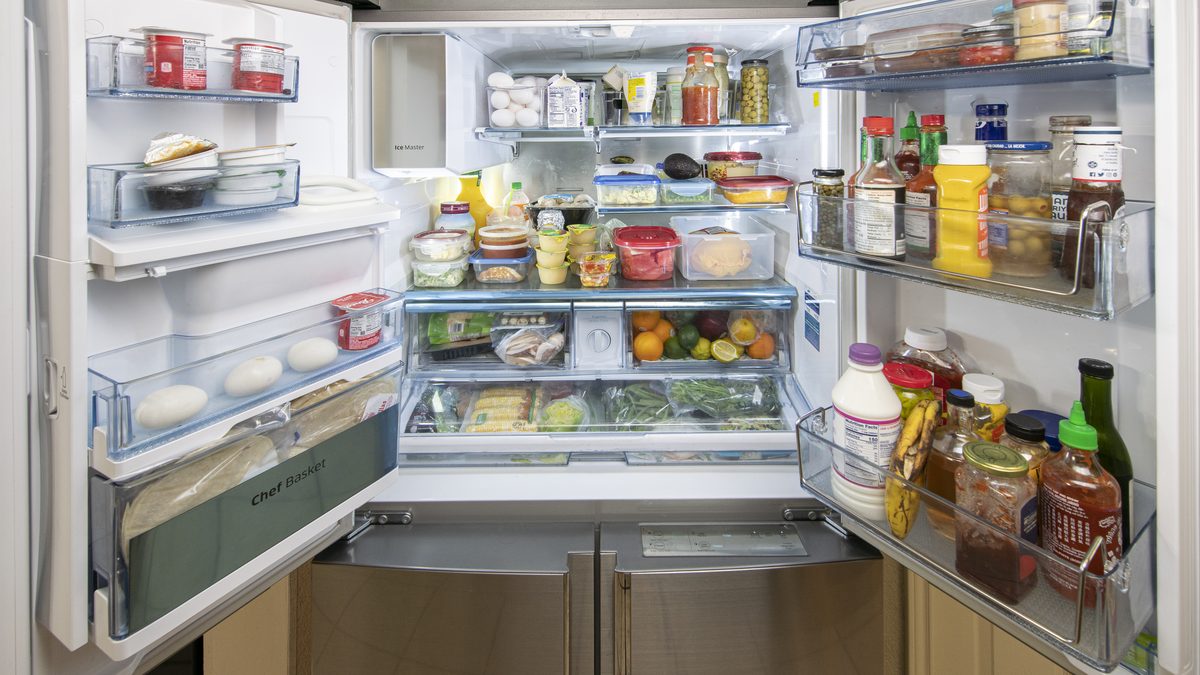
If the power stays off past 4 hours, move the perishables. The USDA says you can transfer food to a cooler filled with ice or frozen gel packs, with "enough ice to keep food in the cooler at 40°F or below," adding more ice as it melts. The CDC gives the same step: once the power has been out for 4 hours, put refrigerated perishable food in a cooler with ice or frozen gel packs.
For a longer outage, dry ice or block ice can buy time. Find out now where you can buy it, the USDA and FDA both say. The figures for how much you need differ by source, so each is listed here.
- USDA FSIS: "Fifty pounds of dry ice should hold an 18-cubic-foot freezer for 2 days."
- FDA: "Fifty pounds of dry ice should keep an 18 cubic foot, fully stocked freezer cold for two days."
- National Center for Home Food Preservation: "a 50-pound block is enough for a full twenty cubic foot freezer for 2 to 3 days."
- Oregon State University Extension: a 50 pound cake of dry ice is enough to protect solidly frozen food in a 20 cubic foot freezer for 36 hours. It adds that 25 pounds would hold a half full 10 cubic foot freezer below freezing for two to three days.
Dry ice is dangerous to handle. The USDA says not to touch it with bare hands or let it touch food directly. Oregon State says to wear heavy gloves, put heavy cardboard on top of the frozen packages and set the dry ice on the cardboard, and to have the seller cut it rather than chipping it yourself. The National Center for Home Food Preservation says not to breathe the gas it gives off.
If anyone in your home takes a medicine that needs to stay cold, Ready.gov says that if the power is out for more than a day, you should discard any medication that should be refrigerated unless the label says otherwise, and call your doctor or pharmacist right away for a new supply.
Do not put food outside in the snow
It is tempting in a winter outage, but the USDA says not to: "Outside temperatures can vary and food can be exposed to unsanitary conditions and animals." University of Georgia Cooperative Extension adds that "Frozen food can thaw in the sun's rays even when the outdoor temperature is below freezing."
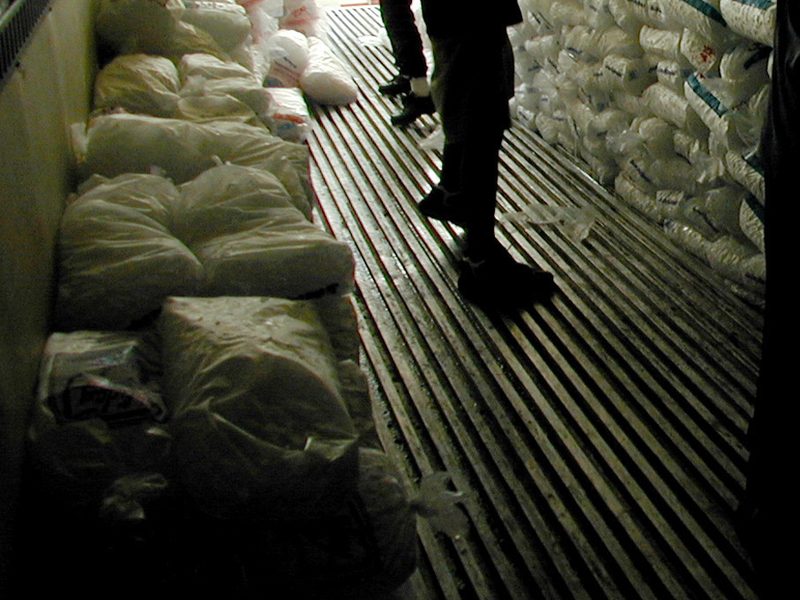
Use the cold another way. The USDA says to fill buckets, empty milk containers or cans with water, leave them outside to freeze, and then use that ice in your refrigerator, freezer or coolers.
Keep or toss: food from the refrigerator
Start with the time and the temperature, because that decides most of it. This is where official sources disagree the most, so each one is listed in its own words.
- FDA, Power Outages: Key Tips: "Discard any perishable food (such as meat, poultry, fish, eggs or leftovers) that has been above 40° F for two hours or more."
- FoodSafety.gov keep or toss chart: the discard column applies to food "Exposed to temperatures of 40°F (4°C) or above for more than 2 hours." The same page also says to discard refrigerated perishable food "after 4 hours without power."
- USDA FSIS: discard its list of perishables "if your refrigerator has been without power for more than 4 hours."
- CDC: "Throw out perishable food in your refrigerator (meat, fish, cut fruits and vegetables, eggs, milk, and leftovers) after 4 hours without power or without a cold source like ice."
- FDA, Food and Water Safety During Power Outages and Floods: discard refrigerated perishable food "that has been at refrigerator temperatures above 40°F for 4 hours or more." It adds that perishable foods measured at 45°F or below with a food thermometer "should be safe, but should be cooked and consumed as soon as possible."
- Ready.gov: "Throw away any food that has been exposed to temperatures 40 degrees or higher for two hours or more."
- American Red Cross: "Throw out food that has been warmer than 40 degrees F." It gives no time limit.
- National Center for Home Food Preservation: "If food has been 40 degrees F or higher for more than 2 hours, then discard it."
The FDA's two pages give different hours, 2 on one and 4 on the other, so we have not picked between them. The two hour rule is the stricter one, and it is the one the FDA's outage tips, FoodSafety.gov's chart, Ready.gov and the National Center for Home Food Preservation all use. If you have no thermometer reading and the power was off more than 4 hours, the USDA, the CDC, the FDA and FoodSafety.gov all say the perishables go.
Throw out these refrigerated foods after 4 or more hours without power, per the USDA's list:
- raw, cooked or leftover meat, poultry, fish, eggs and egg substitutes
- lunch meat and hot dogs
- casseroles, soups, stews and pizza
- mixed salads such as chicken, tuna, macaroni and potato salad
- gravy and stuffing
- milk, cream, yogurt, sour cream and soft cheeses
- cut fresh fruit and vegetables, and cooked vegetables
- creamy salad dressing
- batters and doughs, such as pancake batter and cookie dough
- custard, chiffon or cheese pies, and cream filled pastries
- garlic stored in oil
The USDA also says to throw out any food, such as bread or salad greens, that raw meat, poultry or fish juices may have dripped on, and anything with an unusual odor, color or texture.
Usually safe to keep, per the USDA, unless they turn moldy or smell off:
- hard and processed cheeses
- butter and margarine
- whole fresh fruit and vegetables
- unopened fruit and vegetable juices
- dried fruit
- bread, rolls, muffins, cakes and fruit pies, except those with cream cheese frosting or cream fillings
- fresh herbs and spices, flour and nuts
- high acid foods such as mustard, ketchup, relish, pickles, non-creamy salad dressings, jams and jellies, which the USDA says "may spoil sooner"
Opened mayonnaise, tartar sauce and horseradish get their own rule. The USDA says to discard them "if they were held above 50 °F for over 8 hours," and FoodSafety.gov's chart says the same.
FoodSafety.gov's chart and the USDA list mostly agree, but they split on a few items, so check these against both.
- Opened juice: the USDA says to discard opened fruit and vegetable juices. FoodSafety.gov's chart says keep opened fruit juice and discard opened vegetable juice.
- Coconut: the USDA lists "dried fruits and coconut" as safe. FoodSafety.gov's chart says discard "Sliced or shredded coconut."
- Cheese: both say keep hard and processed cheeses. FoodSafety.gov's chart adds that shredded cheeses and low fat cheeses should be discarded.
- Foods only the chart lists: FoodSafety.gov's chart also says to discard cooked pasta, rice and potatoes, fresh pasta, cheesecake, opened spaghetti sauce, fish and oyster sauces, opened baby formula and pre-cut packaged greens, and to keep peanut butter, opened canned fruit, olives, and soy, Worcestershire, barbecue and hoisin sauces.
Keep or toss: frozen food, and when you can refreeze
Frozen food is more forgiving, because much of it can be refrozen. The agencies all use the same test: ice crystals, or 40°F or below.
- FDA: "If the food still contains ice crystals or is 40° F or below, it is safe to refreeze or cook."
- CDC: "You can safely refreeze or cook thawed frozen food that still contains ice crystals or is at 40 °F or below."
- FoodSafety.gov: "Food may be safely refrozen if it still contains ice crystals or is at 40°F (4°C) or below, however, its quality may suffer."
- USDA FSIS: foods that still contain ice crystals, or that "have remained at refrigerator temperatures," 40°F or below, "may be safely refrozen; however, their quality may suffer."
- National Center for Home Food Preservation: food can be refrozen if it still has ice crystals, or if "the freezer temperature has remained at 40°F or below." It says to check that color and odor are good before using it, and that "Quality of the food will be lower."
- Oregon State University Extension: you can also refreeze many fully thawed foods "if they have been kept at a temperature no higher than 40°F for no longer than two days." It says to discard thawed cooked meat and blanched or cooked vegetables that no longer have ice crystals, and that it is best not to refreeze raw fish and shellfish that have thawed completely.
- University of Georgia Cooperative Extension (2018): sets a colder line for the freezer thermometer: "If the appliance thermometer stored in the freezer reads 0 F or below, the food is safe and may be refrozen."
FoodSafety.gov's frozen food chart gives the item by item answer. With ice crystals still in it, nearly everything can go back in the freezer, but there are exceptions and limits worth knowing.
- Ice cream and frozen yogurt: discard, even if it still has ice crystals.
- Meat, poultry, seafood, soups, stews, milk, eggs, soft cheeses and frozen meals: refreeze if still icy; discard if above 40°F for more than 2 hours.
- Hard cheese, bread, cakes without custard fillings, flour, nuts, waffles, pancakes and bagels: refreeze either way.
- Fruit and fruit juice: refreeze either way, but discard if mold, a yeasty smell or sliminess develops.
- Vegetables and vegetable juice: refreeze if still icy; discard after more than 6 hours above 40°F.
- Cakes, pies and pastries with custard or cheese filling: refreeze if still icy; otherwise discard.
Refrozen food can lose texture, flavor and quality, FoodSafety.gov, the USDA and the extension services all say, so plan to eat it first.
If you do not know how long the power was out
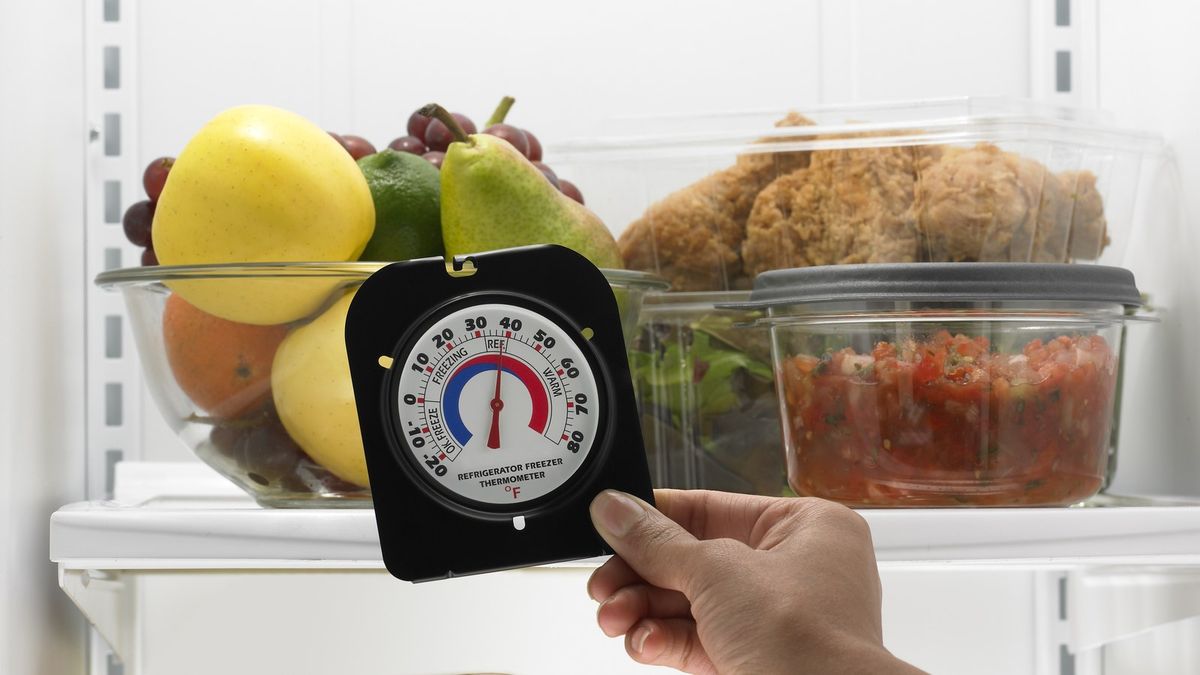
A thermometer answers the question for you. The FDA says that if an appliance thermometer was kept in the freezer and it reads 40°F or below when the power comes back, "the food is safe and may be refrozen." For the fridge, the CDC says to check whether it is still at 40°F or below.
With no thermometer in the freezer, check each package. The FDA says to look for ice crystals or a temperature of 40°F or below, and warns, "You can't rely on appearance or odor." A food thermometer pushed into the food gives you a real reading.
Never taste food to find out if it is safe. The USDA, FoodSafety.gov and the CDC all say it, and all use the same rule: when in doubt, throw it out. The CDC notes that unsafe food "can make you sick even if it looks and smells normal." A bad smell is a reason to throw food away, and a good smell is no reason to keep it.
For questions about a specific food, the USDA Meat and Poultry Hotline is 1-888-674-6854 (1-888-MPHotline), open Monday through Friday from 10 a.m. to 6 p.m. ET, with a live chat in English or Spanish.
Before the next outage
Put an appliance thermometer in both the fridge and the freezer. The USDA, FDA and CDC all say to keep one in each, with the fridge at 40°F or below and the freezer at 0°F or below. A thermometer that records the warmest temperature reached can also show how warm the fridge or freezer got while you were away or asleep.
If you are sizing a battery station to keep a fridge cold during a short outage, our free power station size calculator estimates watt-hours from sourced defaults you can edit. Food-safety times still come from the USDA rules on this page.
Keep the freezer full. The USDA says to fill empty space with frozen jugs of water, bags of ice or gel packs, and to freeze leftovers, milk and fresh meat you will not need right away so they stay cold longer. The FDA notes a bonus: if your normal water supply is contaminated or unavailable, the melting ice "will also supply drinking water." Our guide to storing water for emergencies covers containers and how much to keep, including how much headspace to leave when you freeze water. Our emergency water storage containers page compares the household cans we use for that job.
Have a large insulated cooler and frozen gel packs ready, the USDA and CDC both say, and know where to buy dry ice and block ice. The National Center for Home Food Preservation also suggests keeping blankets on hand to wrap the freezer, kept away from the compressor.
If you plan to run your fridge on a generator or a power station during a long outage, our guide to how far a generator should be from the house covers where to put a generator and how to connect it safely, and our comparison of portable power stations and generators covers which one can keep a fridge running. For a compact apartment station, see our power station picks for a fridge or CPAP. For food that needs no fridge at all, our 90 day guide to life without grid power covers what to stock. Our power outage kit list covers the rest of a two week home supply.
Doom Signals earns from qualifying Amazon purchases.
EcoFlow states this station at 768Wh, 800W rated output, and X-Boost 1600W. It is the top pick on our page for a fridge or CPAP power station in an apartment. We did not measure a fridge or a CPAP on it.
Gear that helps
What to look for: an appliance thermometer for the fridge and one for the freezer (USDA, FDA, CDC), and a large insulated cooler with frozen gel packs that can hold food at 40°F or below (USDA).
Doom Signals earns from qualifying Amazon purchases.
Taylor Digital Fridge/Freezer Thermometer
Taylor lists this battery powered thermometer with a display that shows the current temperature and the minimum and maximum temperatures, and gives a range of minus 4°F to 140°F. The maximum reading matters most in an outage, because it shows how warm the fridge or freezer got while the power was off.
AcuRite fridge and freezer thermometer (model 00986M)
AcuRite lists this as a refrigerator and freezer thermometer with two wireless sensors, one for the fridge and one for the freezer, plus a display that records high and low temperatures and can alarm if a reading leaves a set range. The official temperature range is minus 40°F to 100°F. The USDA, FDA and CDC say to keep a thermometer in both the fridge and the freezer.
Coleman 50-quart Xtreme 5-Day hard cooler
Coleman states that its 50-quart Xtreme 5-Day hard cooler keeps ice up to 5 days at temperatures up to 90°F. The USDA and CDC both say to have a large insulated cooler and frozen gel packs ready before an outage. We did not test ice retention.
Checked Saturday, Nov 21, 2026, 11:10 AM ET. No prices listed because they change daily.
FAQ
How long does food last in the fridge without power?
About 4 hours if the door stays closed. The FDA says a closed refrigerator keeps food cold for about 4 hours, and the USDA, CDC and FoodSafety.gov say it keeps food safe for up to 4 hours.
How long does food last in a freezer without power?
About 48 hours if it is full and 24 hours if it is half full, with the door closed (USDA FSIS, FDA, CDC, FoodSafety.gov, American Red Cross). The National Center for Home Food Preservation says a loaded freezer usually stays frozen two to four days depending on its size, while Oregon State University Extension says 15 to 20 hours for a well-filled freezer.
When should I throw out food after a power outage?
Throw out perishable food such as meat, poultry, fish, eggs and leftovers that has been above 40°F for two hours or more, the FDA's power outage tips say, and FoodSafety.gov's chart uses 40°F or above for more than 2 hours. The USDA and CDC say to throw out refrigerated perishables after 4 hours without power or without a cold source like ice.
Can I refreeze food after the power comes back?
Yes, if it still has ice crystals or is at 40°F or below, though quality may suffer (FoodSafety.gov, FDA, CDC, USDA FSIS). FoodSafety.gov's chart says to throw out thawed ice cream and frozen yogurt even if they still have ice crystals.
Can I tell if food is safe by smelling or tasting it?
No. Never taste food to check it, and the FDA says you can't rely on appearance or odor. When in doubt, throw it out (USDA FSIS, FoodSafety.gov, CDC).
Which foods are usually safe to keep?
Hard and processed cheeses, butter, whole fresh fruit and vegetables, unopened juice, bread and high-acid condiments like ketchup and mustard, unless they turn moldy or smell off (USDA FSIS list).
Should I put food outside in the snow to keep it cold?
No. The USDA says outdoor temperatures vary and food can be exposed to unsanitary conditions and animals. Fill buckets, empty milk containers or cans with water, freeze them outside, and use that ice in your fridge, freezer or cooler instead.
What if I do not know how long the power was out?
Check the temperature. If an appliance thermometer in the freezer reads 40°F or below, the FDA says the food is safe and may be refrozen. With no thermometer, check each package: food that still has ice crystals or is at 40°F or below is safe to refreeze or cook (FDA).
More prep guides are on our guides page, and storm safety lives on our hurricanes page. To get the next guide by email, subscribe here. How we pick and check sources is on our methodology page.
Sources
- USDA Food Safety and Inspection Service, Keep Your Food Safe During Emergencies: Power Outages, Floods & Fires
- FDA, Power Outages: Key Tips for Consumers About Food Safety
- FDA, Food and Water Safety During Power Outages and Floods
- FoodSafety.gov, Food Safety During Power Outage
- CDC, Keep Food Safe After a Disaster or Emergency (Nov. 24, 2025)
- Ready.gov, Power Outages
- American Red Cross, Power Outage Safety
- National Center for Home Food Preservation, University of Georgia, General Freezing FAQs and Prepare for Power Outages
- Oregon State University Extension Service, If Your Home Freezer Stops (2013, reviewed 2024)
- Taylor, Digital Fridge/Freezer Thermometer product page
Image: U.S. Department of Agriculture (public domain).
All guidance checked Friday, Nov 13, 2026, 11:58 PM ET.