
Power out right now? Start here.
Quick answers
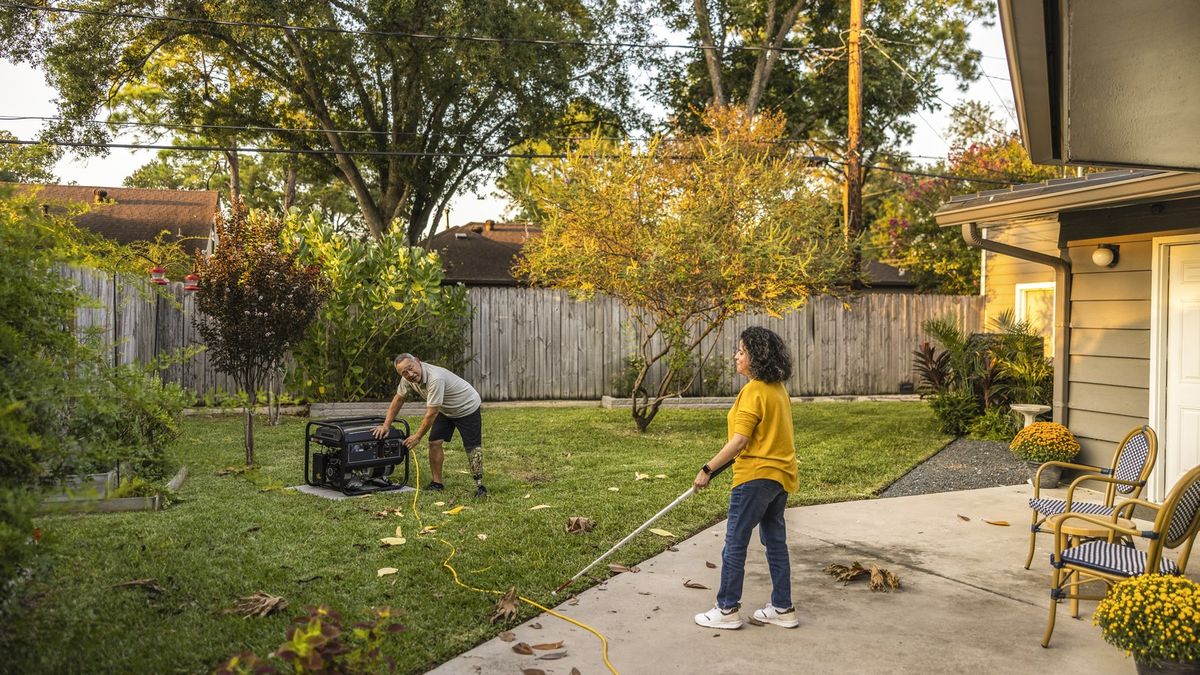
- How far from the house? At least 20 feet from doors, windows and vents, exhaust pointed away (CPSC, CDC, NFPA, Ready.gov). NIST research suggests farther is safer.
- Garage with the door open? No, never (CPSC, CDC, NFPA).
- Why is the exhaust so dangerous? Carbon monoxide has no color or smell and can kill in minutes (CPSC, Honda manual).
- CO alarm if the generator is outside? Yes, with battery or battery backup, on every level (CPSC, Ready.gov).
- Connecting to the house? Heavy-duty outdoor cords, or a transfer switch put in by an electrician. Never a wall outlet (CPSC, NFPA, OSHA).
- In the rain? Keep it dry and follow your generator's manual, because the guidance differs (CPSC, Honda manual).
- Best spot outside? Dry, level ground, 20 feet or more from openings, exhaust pointed away and with the wind (CPSC, NFPA, Honda manual).
- Cool down before refueling? Yes, turn it off and let it cool (Ready.gov, NFPA, OSHA).
The short answer: 20 feet, with the exhaust pointed away
The CPSC, CDC, NFPA, Ready.gov and FEMA all give the same number, 20 feet, and NIST's research points farther. The wording changes a little from page to page. Some measure from the house, some from doors, windows and vents, and the CDC's flyer says more than 20 feet. Each one is listed below in its own words, so you can see exactly what each says.
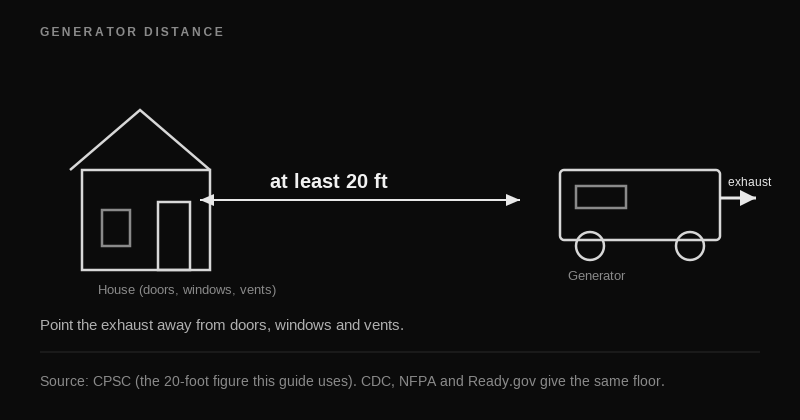
- CPSC, hurricane season release (May 27, 2026): "Operate generators outdoors only, at least 20 feet from homes and buildings, with exhaust directed away from windows, doors and vents."
- CPSC, winter weather release (Jan. 3, 2025): "Operate portable generators outside only, at least 20 feet away from the house." It adds: "Don't operate a generator on a porch or in a carport."
- CPSC, Carbon Monoxide Information Center: "Use generators outside only, at least 20 feet away from homes with exhaust facing away."
- CPSC, Portable Generator Hazards safety alert (2017 edition): "Keep them at least 20 feet from doors, windows, and vents that could allow CO to come indoors."
- CDC, Use a Generator Safely: "keep it outside at least 20 feet away from any doors, windows, or vents."
- CDC, generator flyer: "Only use generators outside, more than 20 feet away from your home, doors, and windows."
- NFPA, Generator Safety tip sheet (2022): "at least 20 feet (7 metres) from all doors, windows, and vent openings. Measure the 20-foot (7 metre) distance from the generator to the building."
- Ready.gov, Power Outages: "Generators and fuel should always be used outdoors and at least 20 feet away from windows, doors and attached garages."
- FEMA, Generator Safety social toolkit: "Only use it outside at least 20ft from homes and garages."
- Washington State Department of Health: "Generators should be at least 20 feet away from buildings."
- NIST, 2009 research (house models): 15 feet from open windows "was not far enough" for the one-story house it modeled, and 25 feet "seemed to be reasonably safe" for that house. For a two-story house, a later NIST study found the generator had to sit farther than 15 feet away, and 30 feet "generally resulted in low CO entry indoors."
- OSHA, Using Portable Generators Safely: no set distance from the house. It says not to use a generator outdoors "if its placement near doors, windows, and vents could allow CO to enter," and to give it "3 to 4 feet of clear space on all sides and above it."
- Honda, EU2200i owner's manual: run it "far away from windows, doors, and vents," and keep it "at least 3 feet (1 meter) away from buildings" for fire safety and cooling.
Two of those numbers are easy to misread. The OSHA figure of 3 to 4 feet and Honda's 3 feet are about air flow, cooling and fire. They are clearance around the machine, and they are not a safe distance from your house for carbon monoxide. For that, the agencies all say 20 feet or more.
You may also see 10 feet on some utility and older pages. The 2009 NIST release noted that "some guidance recommends 10 feet from open windows." That is half the 20 feet the CPSC, CDC, NFPA, FEMA and Ready.gov give today, so treat 20 feet as the floor.
Why some experts say go farther than 20 feet
NIST ran computer models of a generator running outside a house, at different distances and in different winds, for the CDC. For a one-story house, the researchers wrote that "a generator position 15 feet away from open windows was not far enough to prevent carbon monoxide entry into the house," and NIST's news release said people may need to keep generators "perhaps as much as 25 feet" away. A second study of a two-story house found that 30 feet, the next distance it tested after 15, generally kept the carbon monoxide coming inside low, especially with the exhaust pointed away from the house.
NIST researcher Steven Emmerich put it simply: the safe distance "depends on the house, the weather conditions and the unit." The models found that slow, still air was the worst case, because the gas lingered by the windows. They also found carbon monoxide near the house was generally higher when the generator sat downwind of the house, where air swirls behind the building and can trap the exhaust.
Being close to the house is a real risk, the CDC found. Up to half of the nonfatal carbon monoxide poisonings reported in the 2004 and 2005 hurricane seasons involved generators run within 7 feet of the home, according to the CDC, as cited by NIST.
Washington State's Department of Health adds a warning worth keeping in mind: "Even 20 feet away, air flow patterns could still blow carbon monoxide into homes through attic vents, windows, or doors." So 20 feet is the least you should do, and a working carbon monoxide alarm inside is your backup.
Places you should never run a generator
The CPSC says never to run a portable generator inside homes, garages, basements, crawlspaces, sheds or other enclosed areas, "even if doors or windows are open." Its winter release adds porches and carports, which it calls "too close to the home." The NFPA says never in an attached garage, even with the door open, and the CDC says never inside your home or garage, even with doors and windows open. Washington State's health department also lists carports and any "partially-enclosed area."
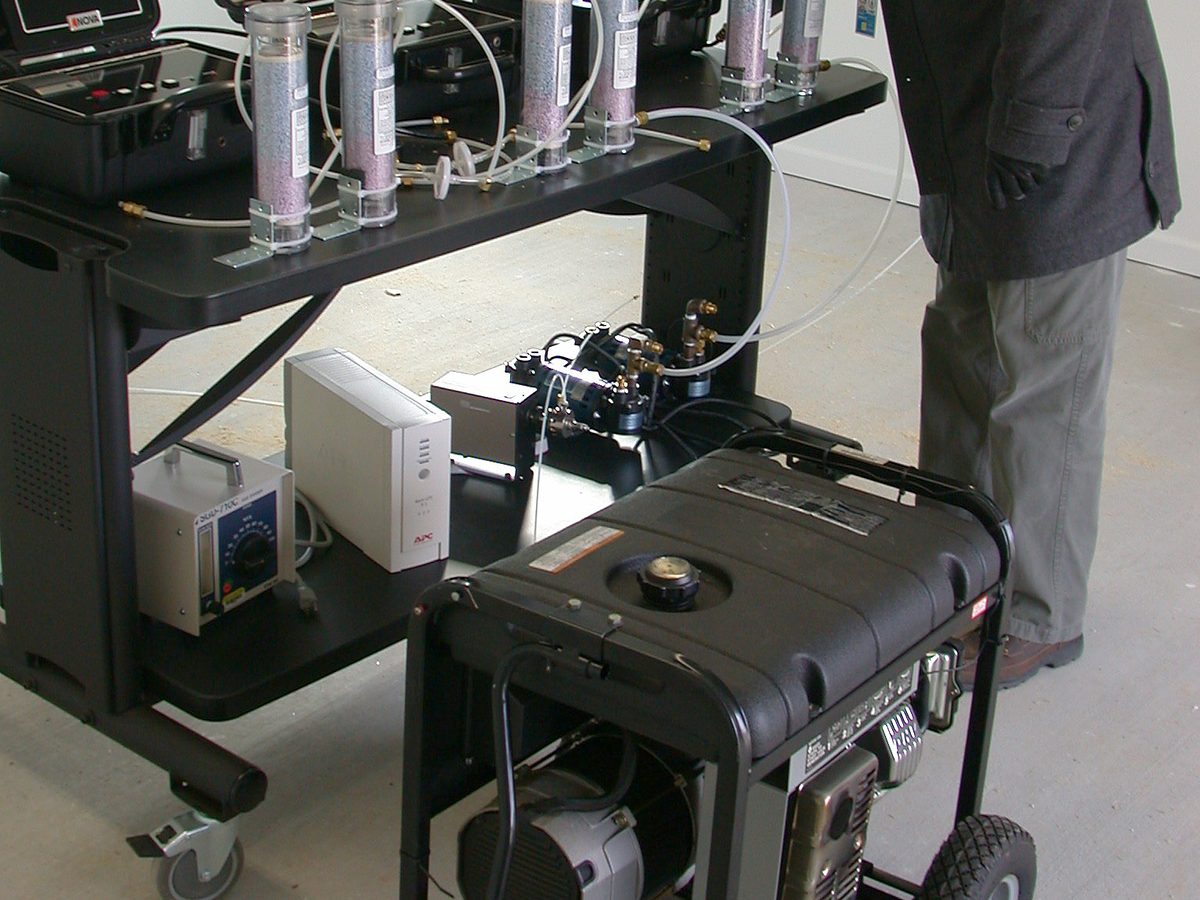
People often ask about a detached garage, a shed, a screened porch or a truck bed. Honda's manual answers most of these in one line: never run it "inside a house, garage, basement, crawl space, any type of vehicle, trailer, or boat, or any enclosed or partly enclosed space." It also says to take the generator completely off any vehicle or trailer before running it. If a spot has walls, a roof or both around the generator, treat it as partly enclosed, and move the generator out into open air.
Opening a door or running a fan does not fix it. The CPSC says opening doors or windows "will not provide enough ventilation to prevent the buildup of lethal levels of CO."
Carbon monoxide: the signs and the alarm you need
Carbon monoxide is a gas with no color and no smell, the CPSC says, and it can kill within minutes, often before people notice symptoms. The CPSC says more than 200 people in the U.S. die every year from carbon monoxide poisoning tied to consumer products, and more than 100 of those deaths are linked to portable generators. One portable generator can make as much carbon monoxide as hundreds of cars, by the CPSC's count.
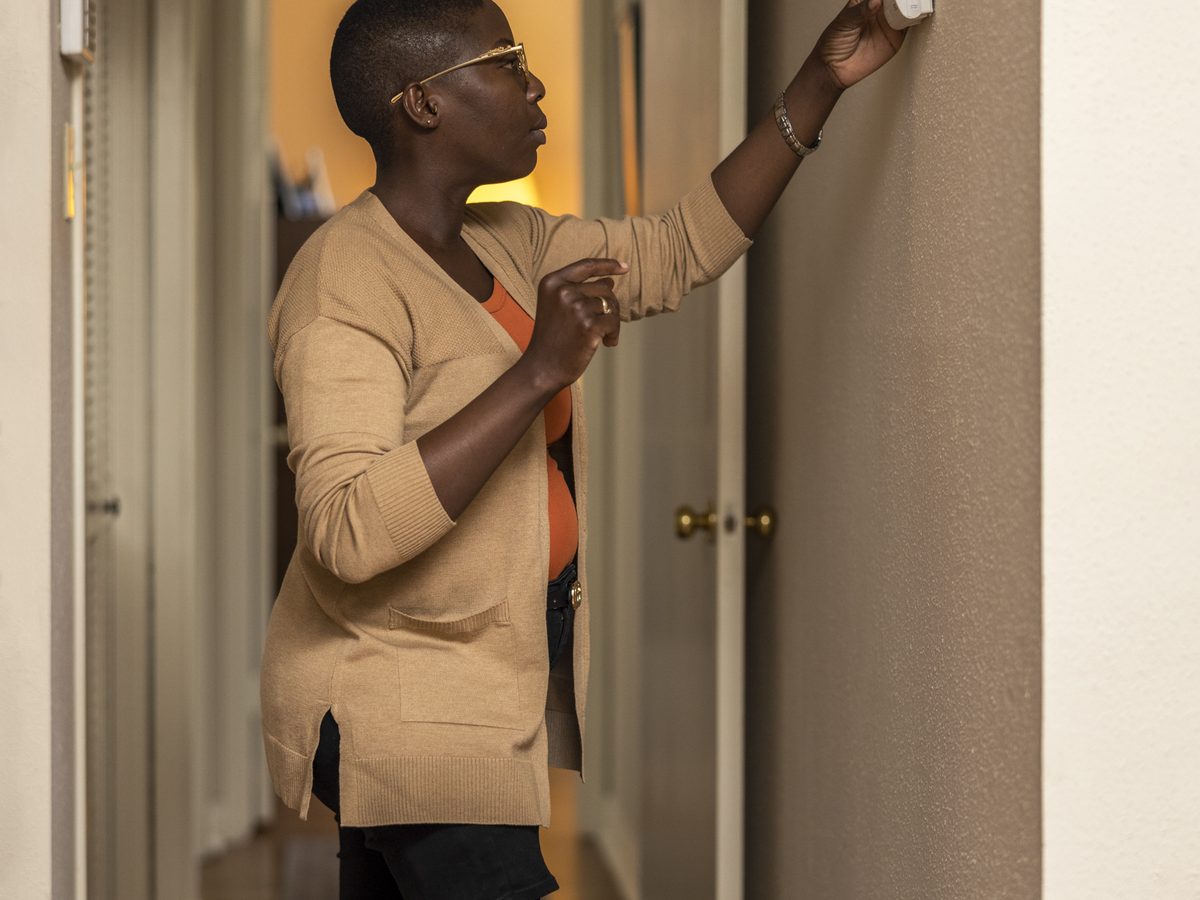
The CPSC lists the symptoms as headache, dizziness, weakness, nausea, vomiting, sleepiness and confusion. If you feel any of them while a generator is running, get outside to fresh air right away, then call 911.
An alarm is the only way to know the gas is there. The CPSC says to install carbon monoxide alarms that run on batteries or have battery backup on every level of the home and outside sleeping areas, and to test them monthly. Ready.gov also says to put detectors with battery backup on every level. The battery part matters most, because a plug-in alarm without one goes quiet in the same outage that has your generator running. The CPSC's safety alert names the standards to look for on the package: UL 2034, IAS 6-96 or CSA 6.19.01. See our carbon monoxide detector picks.
Generators that shut themselves off
Some newer portable generators have a sensor that turns the engine off when carbon monoxide builds up nearby. The CPSC says to look for models certified to PGMA G300-2023 or UL 2201-2023, which it says "include carbon monoxide safety technologies designed to significantly reduce CO poisoning risk." UL 2201 models also put out less carbon monoxide in the first place, the CPSC says.
In January 2025, under the earlier editions of these standards, the CPSC estimated that models certified to PGMA G300-2018 and UL 2201 would reduce deaths from carbon monoxide poisoning "by 87% and 100%, respectively."
A shutoff is a backup and does not make a garage safe. Honda's manual says its own shutoff system "cannot prevent all danger associated with or caused by carbon monoxide," and the distance rules above still apply to every generator.
Running it in rain or snow
Water and electricity are the other big danger. Ready.gov says to keep the generator dry and protected from rain or flooding, because "touching a wet generator or devices connected to one can cause electrical shock."
On covers and tents, official advice differs, so each source is set out here in its own words.
- CPSC safety alert: if you must run it when it is wet outside, "operate the generator under an open, canopy-like structure on a dry surface where water cannot reach it or puddle or drain under it."
- CPSC winter release: follow your generator's instructions, which "may include use of an NFPA-rated non-combustible generator tent or may state to wait until rain passes."
- OSHA: "Keep a generator dry; do not use it in the rain or wet conditions. If needed, protect a generator with a canopy."
- Honda EU2200i manual: "Do not use in the rain or snow," and "Do not enclose or cover the generator with boards or a tent, even when it is outside and away from of a building."
Your own generator's manual has the final word on covers, and any shelter must stay open on the sides so exhaust can escape. Dry your hands before you touch the generator, the CPSC says, and set it where water cannot puddle or drain under it.
Hooking it up to your house
The simplest way is to plug appliances straight into the generator or into heavy-duty outdoor extension cords. The CPSC says to use cords "specifically designed for outdoor use," with a wattage rating higher than everything plugged into them, all three prongs on the plug, and no cuts or tears. The cord also has to be long enough to let the generator sit 20 feet or more away. NIST pointed out that some makers have advised short cords, under 15 feet, which can pull a generator too close to the house.
Never plug a generator into a wall outlet. The CPSC calls this "backfeeding" and says it "presents an electrocution risk to utility workers and neighbors served by the same utility transformer." It also skips some of the home's built-in circuit protection.
If you want to power house circuits, the NFPA says to have a qualified electrician install a properly rated transfer switch, following the National Electrical Code and local codes. OSHA also says a generator should be wired to a building only through a transfer switch put in by a qualified electrician, and it recommends ground fault circuit interrupters (GFCIs), especially around wet or damp spots. GFCIs cut the power when current goes where it should not.
Fuel and refueling
Turn the generator off and let it cool before you add fuel. Ready.gov, the NFPA and OSHA all say this, and Ready.gov explains why: "Fuel spilled on hot engine parts can ignite."
Store fuel in containers made and labeled for it, outside living areas, the NFPA says. The CPSC adds that fuel should never be kept in the home, and not near a fuel-burning appliance such as a gas water heater in a garage. OSHA notes that vapors from spilled fuel "can travel long distances to ignition sources."
For longer outages, our 90-day guide to life without grid power covers making your own power, our comparison of portable power stations and generators covers which one fits a home, and our guide to storing water for emergencies covers the other thing every outage plan needs. Our power outage kit list covers the rest of a two week home supply.
Gear that helps
What to look for: a carbon monoxide alarm that runs on batteries or has battery backup and is certified to UL 2034, IAS 6-96 or CSA 6.19.01 (CPSC), and a generator certified to PGMA G300-2023 or UL 2201-2023 (CPSC).
Doom Signals earns from qualifying Amazon purchases.
Kidde lists this plug-in alarm with two AA backup batteries and a backlit digital display of carbon monoxide levels. Kidde's product data sheet says the unit shall at a minimum meet the requirements of UL 2034. The backup batteries keep it working when the power is out, which is exactly when a generator is running.
Honda says all of its portable generators, the EU2200i included, now carry an updated CO-MINDER shutoff that meets ANSI/PGMA G300-2023, stopping the engine at 600 parts per million of carbon monoxide at the generator or a 10-minute average of 400 parts per million. Honda says its earlier version met the 2018 edition, so check that the box or listing names G300-2023.
Outdoor-rated, three-prong heavy-duty cord
Pick one rated for outdoor use, with a wattage rating above everything you will plug in, all three prongs, and enough length to keep the generator 20 feet or more from the house (CPSC).
OSHA says GFCIs and extension cords with built-in GFCI protection add protection around wet or damp spots.
Checked Friday, Nov 13, 2026, 11:50 PM ET. No prices listed because they change daily.
FAQ
How far should a portable generator be from the house?
At least 20 feet from doors, windows and vents, with the exhaust pointed away (CPSC, CDC, NFPA, Ready.gov). NIST research suggests farther is safer: 15 feet was not enough for the houses it modeled, 25 feet seemed reasonably safe for a one-story house, and 30 feet generally kept carbon monoxide low in a two-story house.
Can I run a generator in the garage if the door is open?
No. The CPSC, CDC and NFPA all say never run a generator in a garage, even with the door or windows open.
Why is generator carbon monoxide so dangerous?
You cannot see or smell it, and it can kill in minutes (CPSC, Honda manual). It can reach the house even from outside if the generator is too close.
Do I need a carbon monoxide alarm if the generator is outside?
Yes. Use carbon monoxide alarms that run on batteries or have battery backup, on every level of the home and outside sleeping areas (CPSC, Ready.gov).
How do I connect a generator to my house?
Plug appliances into the generator with heavy-duty outdoor cords, or have a qualified electrician install a transfer switch. Never plug the generator into a wall outlet (CPSC, NFPA, OSHA).
Can I use a generator in the rain?
Keep it dry. The CPSC says to run it on a dry surface under an open, canopy-like structure, never indoors, while Honda's EU2200i manual says not to use it in rain or snow at all. Follow your own model's manual on covers and tents (CPSC, OSHA, Honda manual).
Where is the best place to put a portable generator outside?
Outdoors on a dry, level surface, at least 20 feet from doors, windows and vents, with the exhaust pointed away from the house and in the direction the wind is blowing, and about 3 to 4 feet of clear space around it (CPSC, NFPA, OSHA, Honda manual). NIST found carbon monoxide near the house was generally higher when the generator sat downwind of the house.
Should I let a generator cool before refueling?
Yes. Turn it off and let it cool, because fuel spilled on hot engine parts can catch fire (Ready.gov, NFPA, OSHA).
More prep guides are on our guides page, and storm safety lives on our hurricanes page. To get the next guide by email, subscribe here. How we pick and check sources is on our methodology page.
Sources
- U.S. Consumer Product Safety Commission, CPSC Warns of Generator, Carbon Monoxide and Fire Hazards Ahead of Hurricane Season (May 27, 2026)
- U.S. Consumer Product Safety Commission, As Winter Weather Impacts Millions, CPSC Issues Safety Tips to Help Families Prevent Carbon Monoxide Poisoning and Fires (Jan. 3, 2025)
- U.S. Consumer Product Safety Commission, Carbon Monoxide Information Center
- U.S. Consumer Product Safety Commission, Portable Generator Hazards safety alert (2017 edition)
- CDC, Use a Generator Safely
- CDC, When the Power Goes Out, Keep Your Generator Outside
- National Fire Protection Association, Generator Safety tip sheet (2022)
- Ready.gov, Power Outages
- FEMA, Generator Safety: Stay Safe
- NIST, For Safer Emergencies, Give Your Power Generator Some Space (2009)
- NIST, Technical Note 1637, Phase I study (2009, hosted by CDC)
- NIST, Technical Note 1666, Phase II study (2010, hosted by CDC)
- OSHA, Using Portable Generators Safely
- OSHA, Preventing Carbon Monoxide Poisoning While Working with Portable Generators
- Washington State Department of Health, Generator Use During a Power Outage
- Honda Power Equipment, EU2200i owner's manual and CO-MINDER G300-2023 release (July 15, 2025)
- Kidde, COPD product page
Image: U.S. Consumer Product Safety Commission (public domain).
All guidance checked Friday, Nov 13, 2026, 11:50 PM ET.