
A two week power outage kit comes down to six things: water, food that needs no cooking, light, safe warmth or cooling, a plan for medicine, and a way to keep phones charged. Ready.gov, the federal government's preparedness site, says to store at least one gallon of water per person per day, and a two week supply works out to 14 gallons for each person in the home. The rest of this list follows Ready.gov, the FDA and the Consumer Product Safety Commission, and names a few well reviewed pieces of gear for each job.
Guidance and gear details checked Tuesday, Oct 27, 2026, at 5:45 PM ET. No prices are listed, because they change often.
Quick answers
- How much water do I need? At least one gallon per person per day, Ready.gov says, so 14 gallons per person for two weeks.
- How long does fridge food stay safe? About four hours with the door closed. A full freezer holds its temperature for about 48 hours, and a half full one for about 24.
- When do I throw food out? When it has sat at 40 degrees Fahrenheit or higher for two hours or more, or it smells, looks or feels wrong.
- Can I heat my home with a gas stove? No. Ready.gov says it raises your risk of carbon monoxide poisoning.
- Do I need a carbon monoxide alarm? Yes. Ready.gov says to put carbon monoxide detectors with battery backup on every level of your home.
- What about medicine that must stay cold? Ask your doctor or pharmacist for an outage plan now, including how long it can stay at higher temperatures.
- What should I unplug? Electronics and appliances, because power can come back with surges that damage them.
- What food should I keep? Nonperishable food that needs no cooking, plus a manual can opener.
What a 2 week outage kit needs to cover
A long outage touches more than the lights. Ready.gov says a power outage can disrupt communications, water and transportation, close stores, gas stations, ATMs and banks, spoil food, and stop medical devices from working.
Ready.gov's own kit list is built for "several days," not two weeks, so this list takes its daily amounts and multiplies them out. The core of its basic kit is water, food, a battery powered or hand crank radio with a NOAA Weather Radio tone alert, a flashlight, a first aid kit, extra batteries, a manual can opener, and a cell phone with chargers and a backup battery. It also suggests prescription medicines, glasses and contact lens solution, pet food and extra water for pets, infant supplies, and cash.
In plain terms, plan for each person and pet in your home, then check the list once a year.
Water and food
Water comes first. "Store at least one gallon of water per person per day for several days, for drinking and sanitation," Ready.gov says. It adds that children, nursing mothers and sick people may need more, and that in very hot weather water needs can double.
For two weeks, that is at least 14 gallons per person. See our emergency water storage container picks. A family of four needs at least 56 gallons, more in summer. Ready.gov says to buy commercially bottled water and keep it in the sealed original container in a cool, dark place. It also says, "Never ration drinking water unless ordered to do so by authorities."
If you need to treat water, Ready.gov gives a bleach method: use plain, unscented household bleach with 5.25 to 6.0 percent sodium hypochlorite, add 1/8 teaspoon per gallon, stir, and let it stand 30 minutes. The water should have a slight bleach smell. If it does not, repeat the dose and wait another 15 minutes.
For food, Ready.gov says to keep nonperishable food and water on hand, and its kit list calls for food that needs no cooking. Think canned beans, fish and fruit, peanut butter, crackers, cereal and shelf stable milk. Choose what your household already eats, and rotate it into your normal meals so nothing expires on the shelf.
Light and phone charging
Ready.gov says to have flashlights for every household member, and to plan batteries or other backup power, "such as a portable charger or power bank."
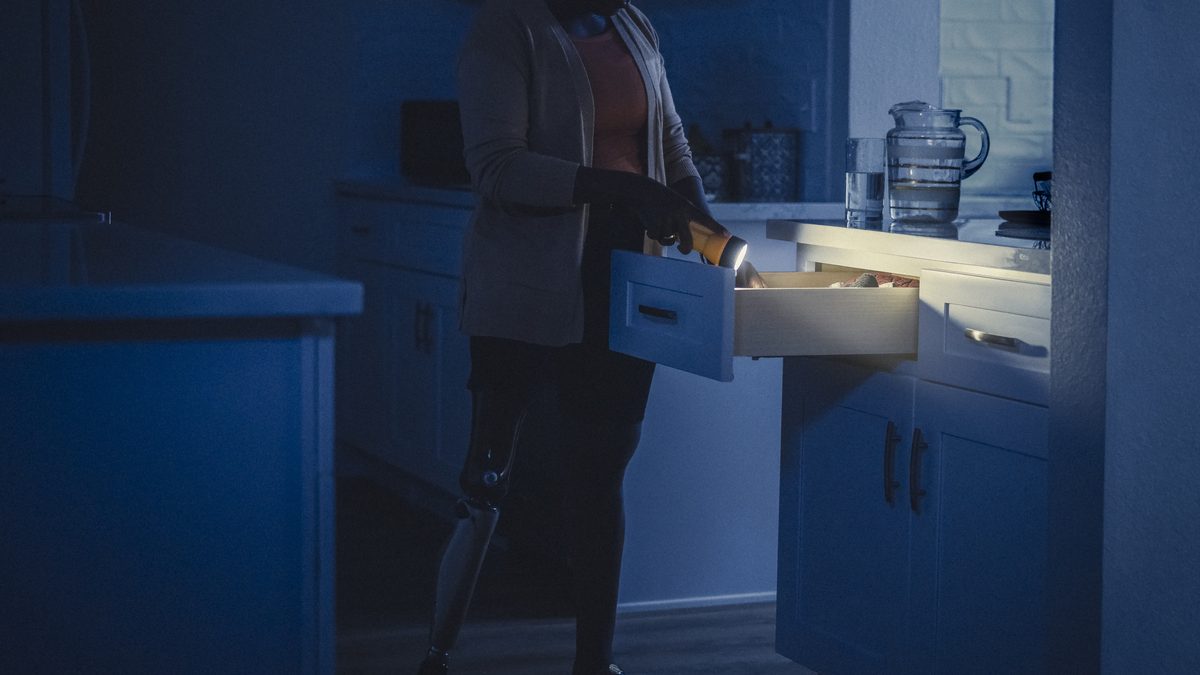
Headlamp. The Black Diamond Astro 300 is one of Wirecutter's picks for power outages. Black Diamond rates it at 300 lumens on high, running on three AAA batteries or its own rechargeable pack, with a rain resistant IPX4 rating. A headlamp keeps both hands free for cooking or checking a breaker.
Lantern. The UST 60-Day Duro LED Lantern is also a Wirecutter outage pick. UST says it runs on six D batteries and lasts up to 60 days on its 20 lumen low setting, with 1,200 lumens on high. One lantern can light a whole room. See our lantern picks for a power outage.
Weather radio. Ready.gov's kit list calls for a NOAA Weather Radio with tone alert. The Midland WR120B is a desktop NOAA weather radio. Midland says it receives NOAA and all-hazard alerts and switches to AA batteries when the power goes out. See our weather radio picks.
Phone charging. For phones alone, a power bank does the job. Look for one whose maker lists its capacity and a UL listing. Power banks are covered by UL 2056, the UL standard for power banks up to 100 watt hours. For more than phones, such as lights, a CPAP machine or a small fridge, see our power station vs generator guide.
Staying warm or cool safely
Ready.gov says to go to a community location with power if heat or cold is extreme, and to check with local officials about heating and cooling locations near you.
Never use a gas stove or oven to heat your home. "It increases your risk of carbon monoxide poisoning," Ready.gov says, and it adds a risk of fires and burns. Generators, camp stoves and charcoal grills belong outdoors only, at least 20 feet from windows, Ready.gov says. Carbon monoxide, it notes, "is a colorless, odorless gas that can kill you, your family and pets."
That is why a carbon monoxide alarm belongs in every kit. See our CO alarm picks for generator and heater use. Ready.gov says to "install carbon monoxide detectors with battery backup in central locations on every level of your home." The Consumer Product Safety Commission says CO alarms should be certified to the latest safety standards: UL 2034, IAS 6-96 or CSA 6.19.01.
CO alarm. The Kidde KN-COPP-3 plug-in carbon monoxide alarm plugs into a wall outlet and has a 9 volt battery backup that, Kidde says, keeps it monitoring during a power outage. Kidde lists it as UL listed, with a digital display that shows CO levels from 30 to 999 parts per million.
For warmth without fuel, layer clothing, use sleeping bags and blankets, and gather the household in one room. If you use a fuel heater, see our indoor-safe heater picks, and never run one while you sleep.
Medicine and medical devices
Ready.gov says to talk to your medical provider about an outage plan for medical devices powered by electricity and for refrigerated medicines. Ask how long each medicine can be stored at higher temperatures, and get specific guidance for any medicine that is critical for life.
After a long outage, Ready.gov says, "If the power is out for more than a day, discard any medication that should be refrigerated, unless the drug's label says otherwise." It says to consult your doctor or pharmacist right away for a new supply.
If someone at home uses a CPAP, oxygen concentrator or other powered device, find out its power draw from the device maker, and plan backup power or a place with power before an outage. Our CPAP or fridge battery picks compare two stations for apartment outages. Ready.gov also suggests checking whether your home phone works in an outage and how long its battery backup lasts.
Keeping your fridge food safe
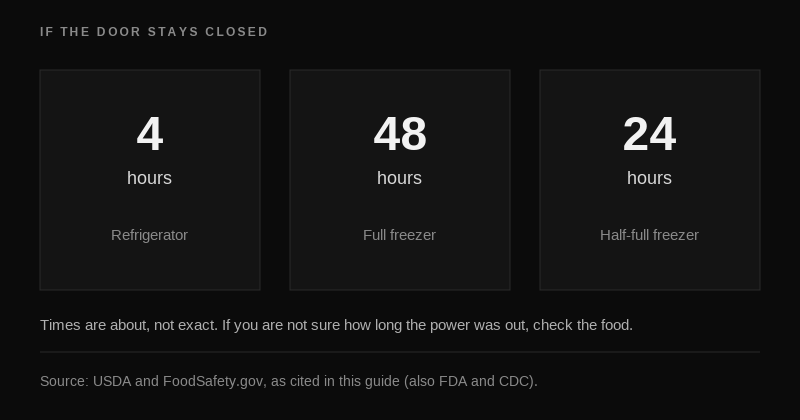
The rule is simple: keep the doors shut. "The refrigerator will keep food cold for about 4 hours if it is unopened," the FDA says. "A full freezer will keep the temperature for approximately 48 hours (24 hours if it is half full) if the door remains closed."
Ready.gov says to use coolers with ice if needed, and to watch temperatures with a thermometer. The FDA says to keep appliance thermometers in both the fridge and freezer, with the freezer at or below 0 degrees Fahrenheit and the fridge at or below 40. Those numbers are what tell you later whether food is safe.
When the power comes back, the FDA says food in the freezer that still has ice crystals or reads 40 degrees or below is safe to refreeze or cook. It says to throw out refrigerated perishable food, such as meat, poultry, seafood, milk, eggs and leftovers, that has been above 40 degrees for four hours or more. Ready.gov's rule of thumb is "When in doubt, throw it out!"
Before an outage, the FDA suggests freezing containers of water and gel packs to help keep food cold, and grouping food together in the freezer.
Printable checklist
Water and food
- At least 14 gallons of water per person, more for hot weather, children, nursing mothers and sick people
- Extra water and food for pets
- Two weeks of nonperishable food that needs no cooking
- Manual can opener
- Unscented household bleach (5.25 to 6.0 percent sodium hypochlorite) for treating water
Light, power and information
- A flashlight or headlamp for each person
- A lantern
- Extra batteries in the sizes your gear uses
- NOAA Weather Radio with tone alert, battery or hand crank
- Phone chargers and a power bank
Health and safety
- Carbon monoxide alarm with battery backup on every level of the home
- First aid kit
- Prescription medicines, and a plan from your doctor for any that need cold storage or power
- Glasses and contact lens solution
- Soap, hand sanitizer, moist towelettes and garbage bags
Food safety
- Appliance thermometers for the fridge and freezer
- A cooler, and frozen water containers or gel packs
Home and paperwork
- Blankets, sleeping bags and warm layers
- Wrench or pliers to turn off utilities
- Cash
- Copies of important documents
Going longer: the 90 day plan
For a plan that runs much longer, with deeper water and food storage and solar power, read our 90 day power outage plan. For live conditions, the Doom Signals monitor tracks official feeds, and our methodology explains how we pick sources.
Sources
- Ready.gov, Water
- Ready.gov, Power Outages
- Ready.gov, Build a Kit
- U.S. Food and Drug Administration, Food and Water Safety During Power Outages and Floods
- U.S. Consumer Product Safety Commission, Safety Alert: Portable Generator Hazards
- UL Standards & Engagement, UL 2056, Power Banks
- Gear specifications are from each maker, as stated in the article. Review picks from Wirecutter's guides to power outage supplies and emergency weather radios.