
Checked Sunday, Oct 25, 2026, at 6:30 PM ET. The Pentagon context comes from the Department of War's own FORTRESS America memo and speech, and from a Fox News report on documents it says it reviewed. The household guidance comes from sources written for the long haul: university extension services, BYU food science, the Church of Jesus Christ of Latter-day Saints storage program, USDA canning research, EPA, Army field manuals, the Department of Energy and FDA.
The Pentagon has said out loud that it no longer trusts the civilian grid to keep its bases running. Ordinary homes have no such plan. Short outage checklists are built for a few days. This is a calm look at what is real, and at what sources built for months say to do if the lights go out and stay out.
Quick answers
- Is the Pentagon really preparing bases for 90 days without power? A 90 day figure has been reported but not published. Fox News Digital reported on Oct 25, 2026, citing documents it reviewed, that under FORTRESS every major base in the continental United States would be expected to sustain essential operations independently for at least 90 days, including electricity, water, fuel and communications. The public memo that created FORTRESS America on Sept 30 gives no number of days.
- What is officially confirmed? On Sept 30, 2026, Secretary of War Pete Hegseth established FORTRESS America and said every major military installation will generate its own power, independent of the civilian grid, so bases stay lit if an adversary takes the grid down by cyberattack or sabotage.
- What did the rules say before this? Army Directive 2020-03 tells Army installations to plan to sustain energy and water for critical missions for a minimum of 14 days when no other duration has been set.
- Does this mean a blackout is coming? No official source says an outage is expected. The Pentagon calls FORTRESS an insurance policy. A senior defense official said on Oct 20 that the department is still assessing costs across about 500 bases, as reported by Air & Space Forces Magazine.
- How much water and food for 90 days? For one adult: 90 gallons of water, 75 pounds of grain and 15 pounds of dry beans. That is USU Extension's gallon of drinking water per person per day times 90, and the Church of Jesus Christ of Latter-day Saints guide of 25 pounds of grain and 5 pounds of dry beans per adult per month times three. No official source publishes a 90 day household list, so these are multiples of those cited figures.
What is real, and what is reported
The confirmed part is the Department of War memo of Sept 30, 2026, "Establishment of FORTRESS America as a Department of War Program for the Defense of the American Homeland." It names five pillars: energy independence; supply chain and defense industrial base resilience; a strategic defense reserve; installation hardening and cyber resilience; and resilience in space and spectrum. It directs a program office to stand up within 30 days.
In his State of the Force address the same day, Hegseth said: "Every major military installation in America is going to generate its own power. Independent of the civilian grid." He named cyberattack and sabotage as the threats.
The 90 day figure comes from Fox News Digital. On Oct 25, 2026, it reported that FORTRESS documents it reviewed set that standard for major bases in the continental United States. Doom Signals has not seen those documents, and the Pentagon has not published the figure. A Pentagon spokesperson, Sean Parnell, told Fox: "We don't want to rely on standard civilian municipal infrastructure to run our national defense."
Air & Space Forces Magazine reported that a senior defense official said on Oct 20 that the work begins with energy: assessments of each installation, then microgrids and battery backup. The official said the full goal could take decades. No budget or completion date has been announced.
The older floor still stands. Army policy since 2020 plans for at least 14 days of energy and water for critical missions. Federal law, 10 U.S.C. 2920, directs the Pentagon to make the energy load for critical missions available 99.9 percent of the time by the end of fiscal year 2030.
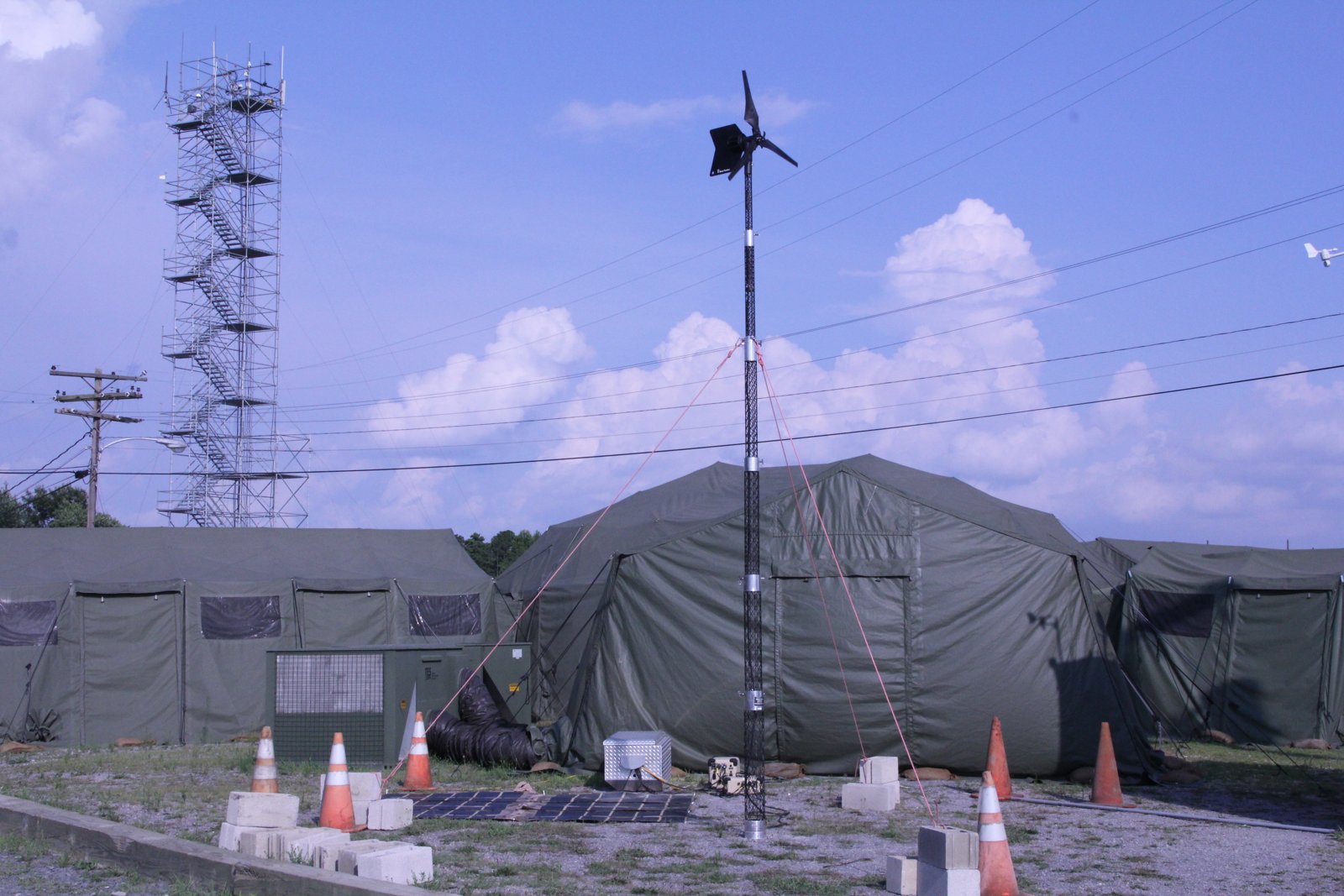
A tactical microgrid at Fort Dix, N.J., July 23, 2012. Photo: Spc. Robert Porter, U.S. Army, public domain, via Wikimedia Commons.
That is the signal. The military is planning for an outage long enough that it no longer wants to depend on the grid at all. Your household is still on the grid.
Food that lasts
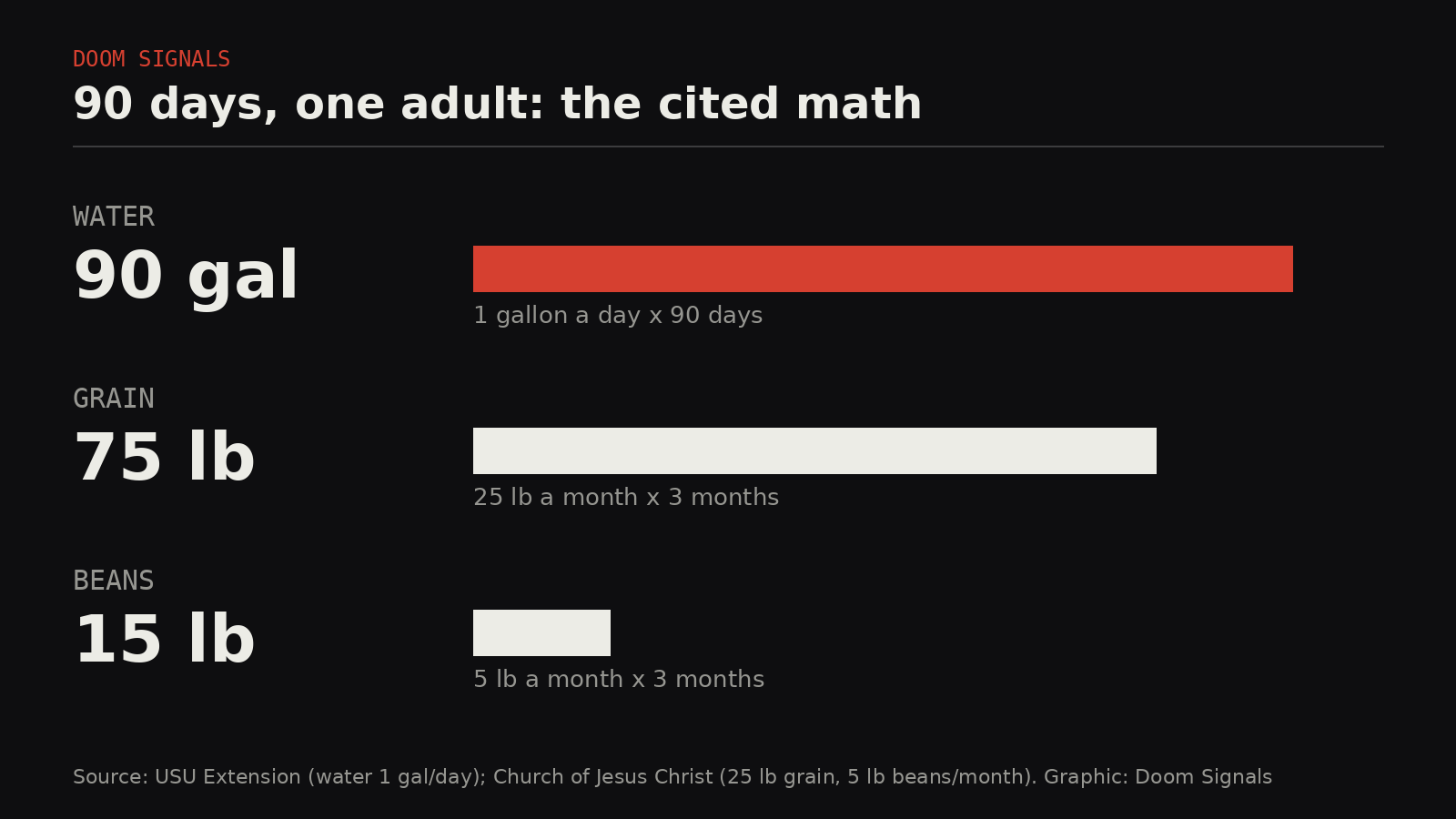
90 days for one adult, multiplied from USU Extension and Church of Jesus Christ of Latter-day Saints figures. Graphic: Doom Signals.
Short term pantries rot or run out. Long term storage is built on dry staples. The Church of Jesus Christ of Latter-day Saints, which has run a home storage program for decades, lists wheat, white rice, corn and sugar at 30 years or more, and pinto beans, rolled oats and pasta at 30 years, when properly packaged and stored at 75°F (24°C) or below. It plans 25 pounds of grains and 5 pounds of dry beans per adult per month. Products should be dry, about 10 percent moisture or less, and it warns that moist products in reduced oxygen packaging can cause botulism.
BYU's Department of Nutrition, Dietetics and Food Science publishes "An Approach to Longer-Term Food Storage," revised June 2024, a list it says likely gives one adult adequate calories and protein for a year. It includes 24 #10 cans of wheat (about 132 pounds), 12 cans of white rice and 12 cans of legumes. It rates oils at about 1 year, so they need rotating. It warns that less than 10 milligrams of vitamin C a day can cause scurvy within a few months, and that attics and garages shorten shelf life sharply. It also lists the tools people forget: a can opener, a grain grinder and recipes that use only stored food.
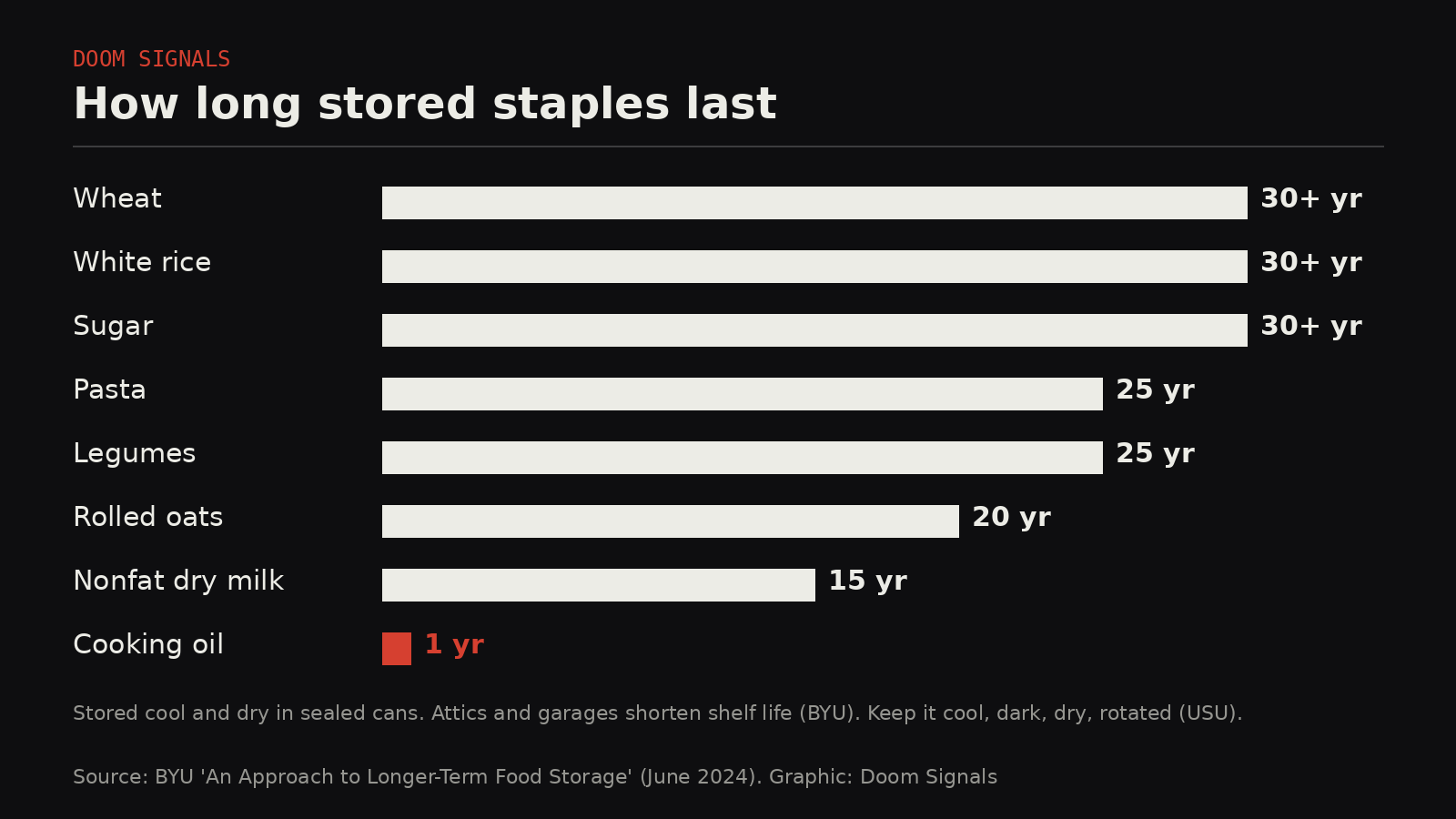
Shelf life of stored staples, from BYU's food storage guide (June 2024). Graphic: Doom Signals.
These figures are tested, not guessed. A BYU sensory study found wheat stored in #10 cans up to 32 years and white rice up to 30 years still acceptable for emergency use.
USU Extension adds the dull rules that keep a store alive: cool, dark, dry, airtight, and rotated.
If you can or preserve food, follow USDA tested methods from the National Center for Home Food Preservation. Pressure canning is the only recommended method for meat, poultry, seafood and vegetables, because botulism spores survive a boiling water bath in low acid foods.
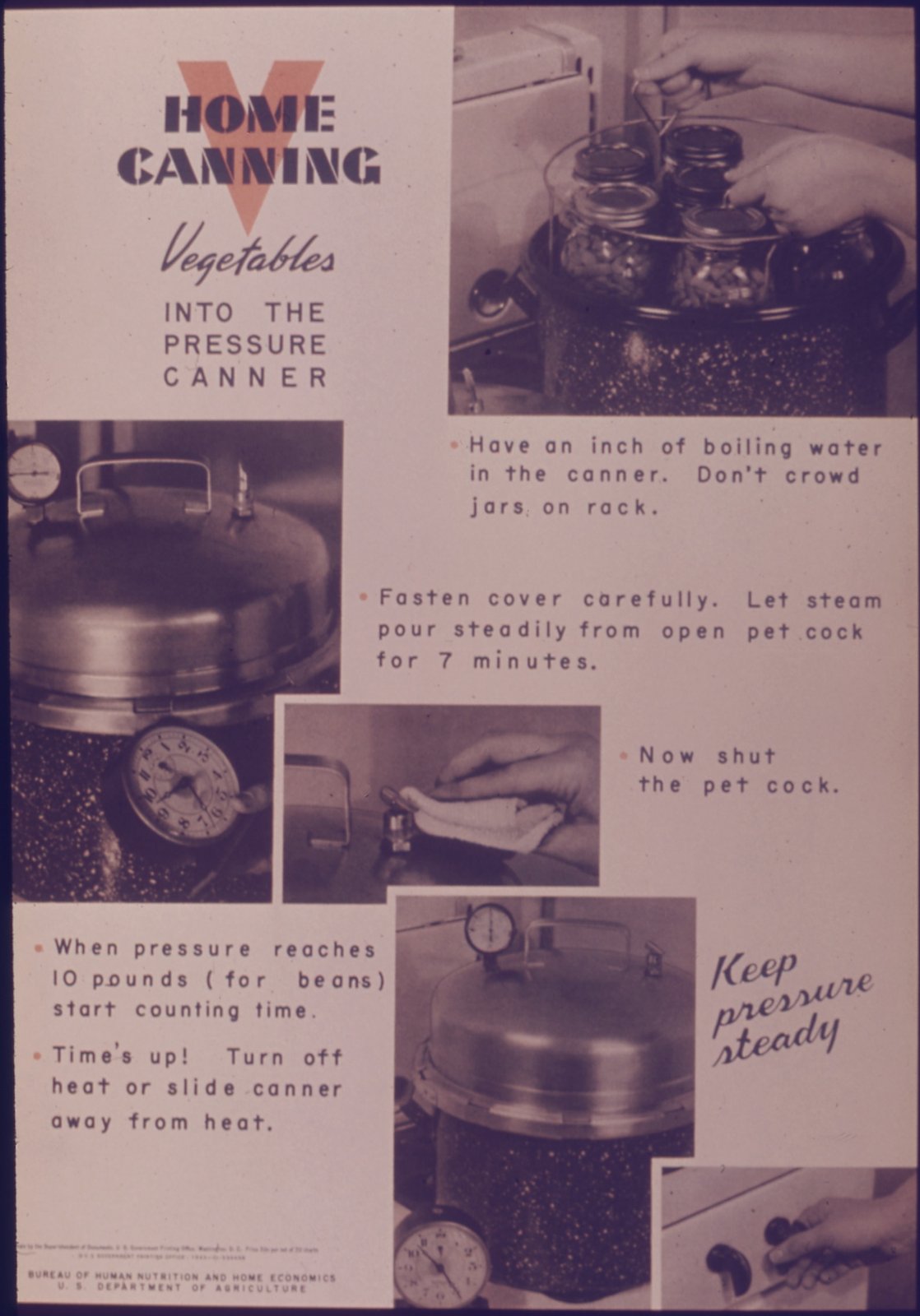
"Home Canning Vegetables Into the Pressure Canner," 1941 to 1945. National Archives, public domain, via Wikimedia Commons.
Water for months
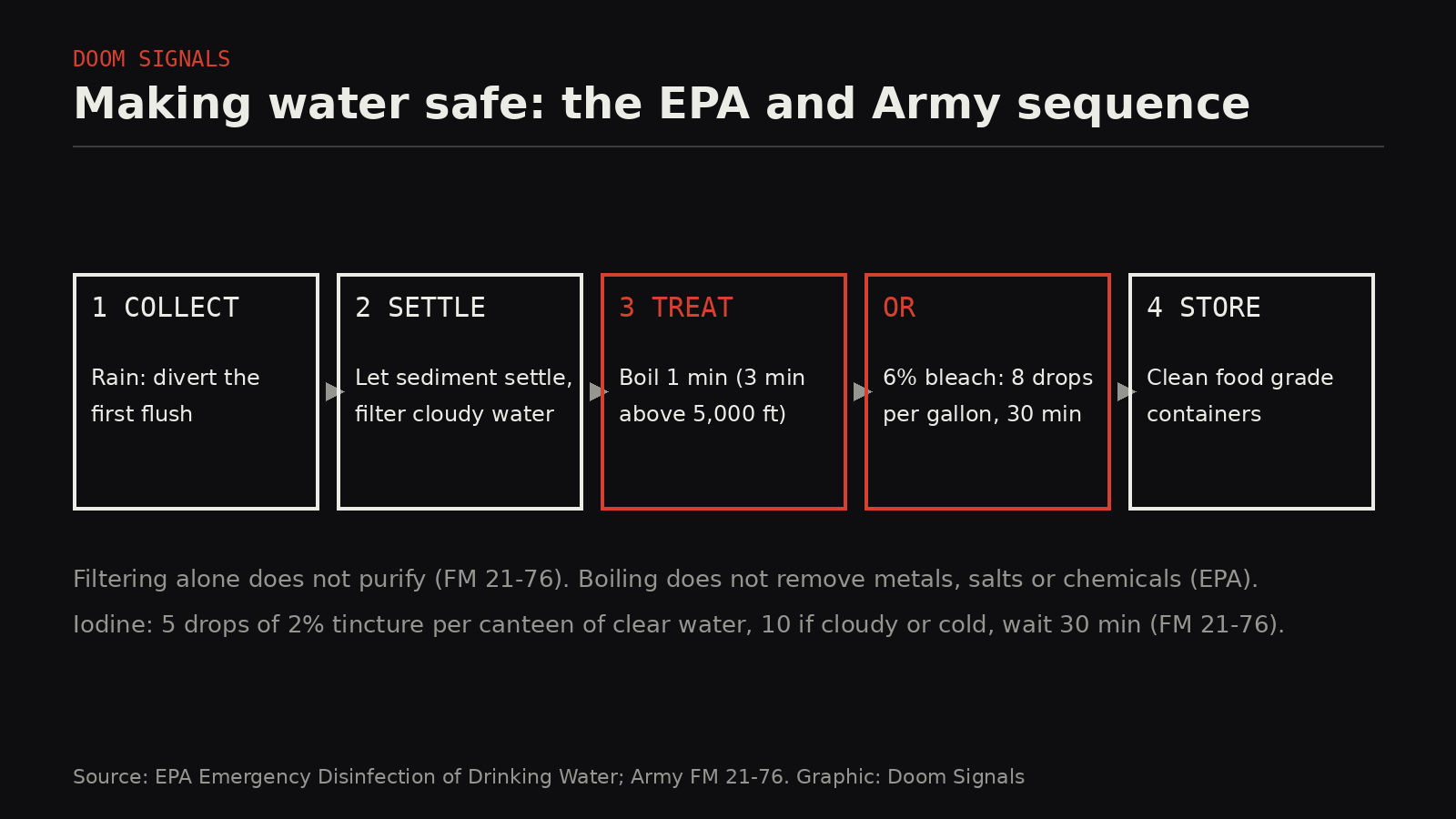
Making water safe, step by step, from EPA and Army FM 21 76 guidance. Graphic: Doom Signals.
Stored water buys time. Treatment buys months. USU Extension says properly disinfected stored water keeps indefinitely, rotated every six months for taste, in food grade containers.
EPA's emergency disinfection guidance: boil water for one minute, or three minutes above 5,000 feet. Boiling does not remove metals, salts or chemicals. Without fuel, add 8 drops of unscented 6 percent bleach per gallon (6 drops for 8.25 percent), stir and wait 30 minutes. If it does not smell faintly of chlorine, repeat and wait another 15 minutes. Army Field Manual FM 21-76 gives 5 drops of 2 percent iodine per canteen of clear water and 10 for cloudy or cold water, with a 30 minute wait, and warns that filtering alone does not purify.
Rain is the obvious long haul source. Texas A&M AgriLife Extension advises filtering harvested rainwater and disinfecting it with chlorine, UV or ozone before drinking, and diverting the first flush off the roof.
A private well is not a grid free source if its pump is electric. Mississippi State Extension publication P3398 covers shock chlorination of wells with working submersible pumps: hold the chlorinated water in the plumbing at least eight hours, then flush and test before drinking.
Sanitation the Army way
When toilets stop, disease starts. Army ATP 4-25.12, Unit Field Sanitation Team, prefers chemical toilets and names the burn out latrine as the preferred improvised device. Site latrines 100 meters or more from food and 30 meters or more downslope from wells, springs and streams. Keep handwashing next to them.
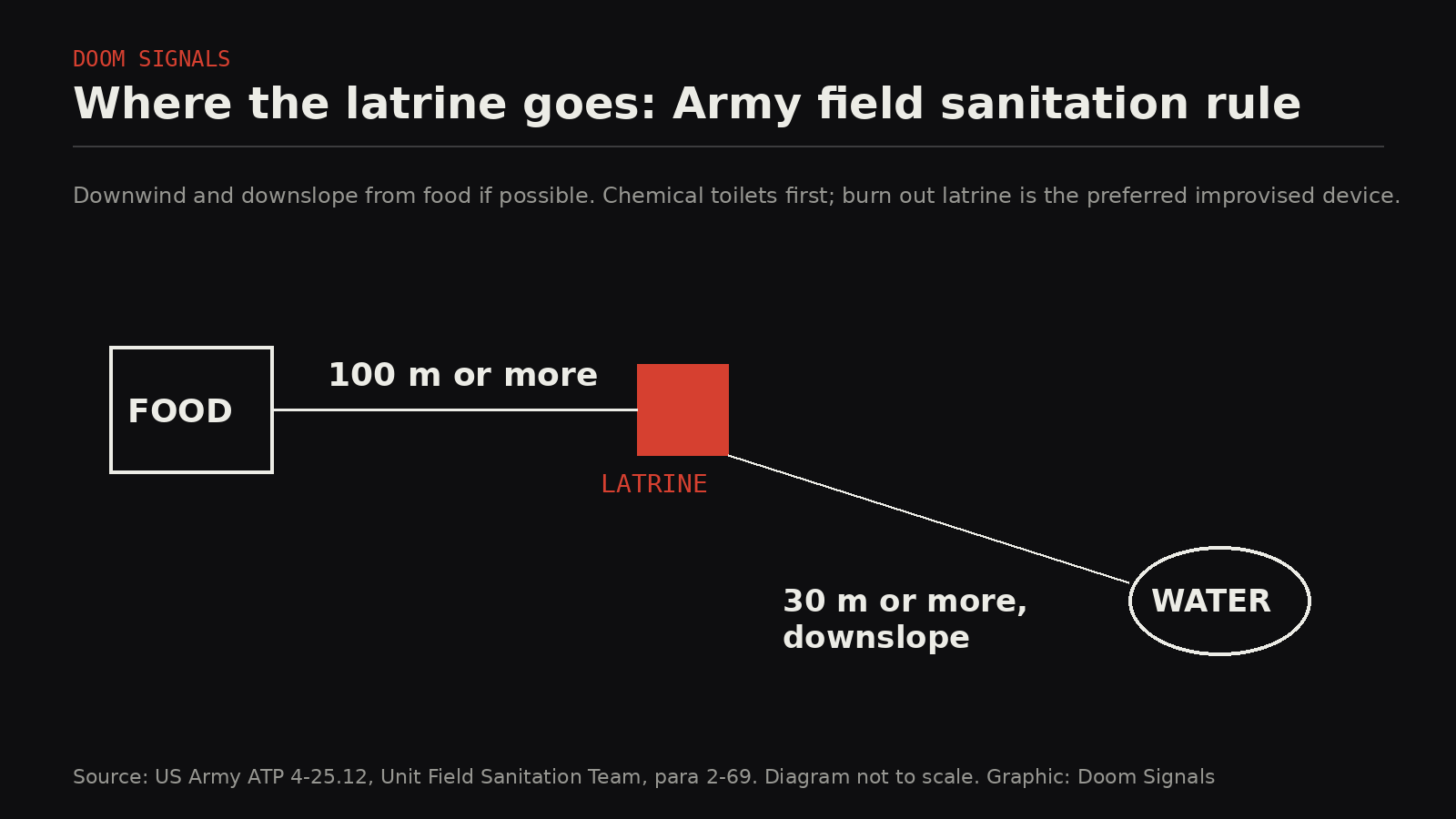
Latrine siting from Army ATP 4 25.12. Not to scale. Graphic: Doom Signals.
FM 21-76, the Army survival manual, is free to read and covers water, shelter, fire and food when nothing else works.
Power you make yourself
Rooftop solar alone does not keep your lights on. The Department of Energy says grid tied panels shut off in an outage unless the system has the right inverter and battery storage. NREL notes that a system must be able to island from the grid, and batteries are what carry power past sundown.
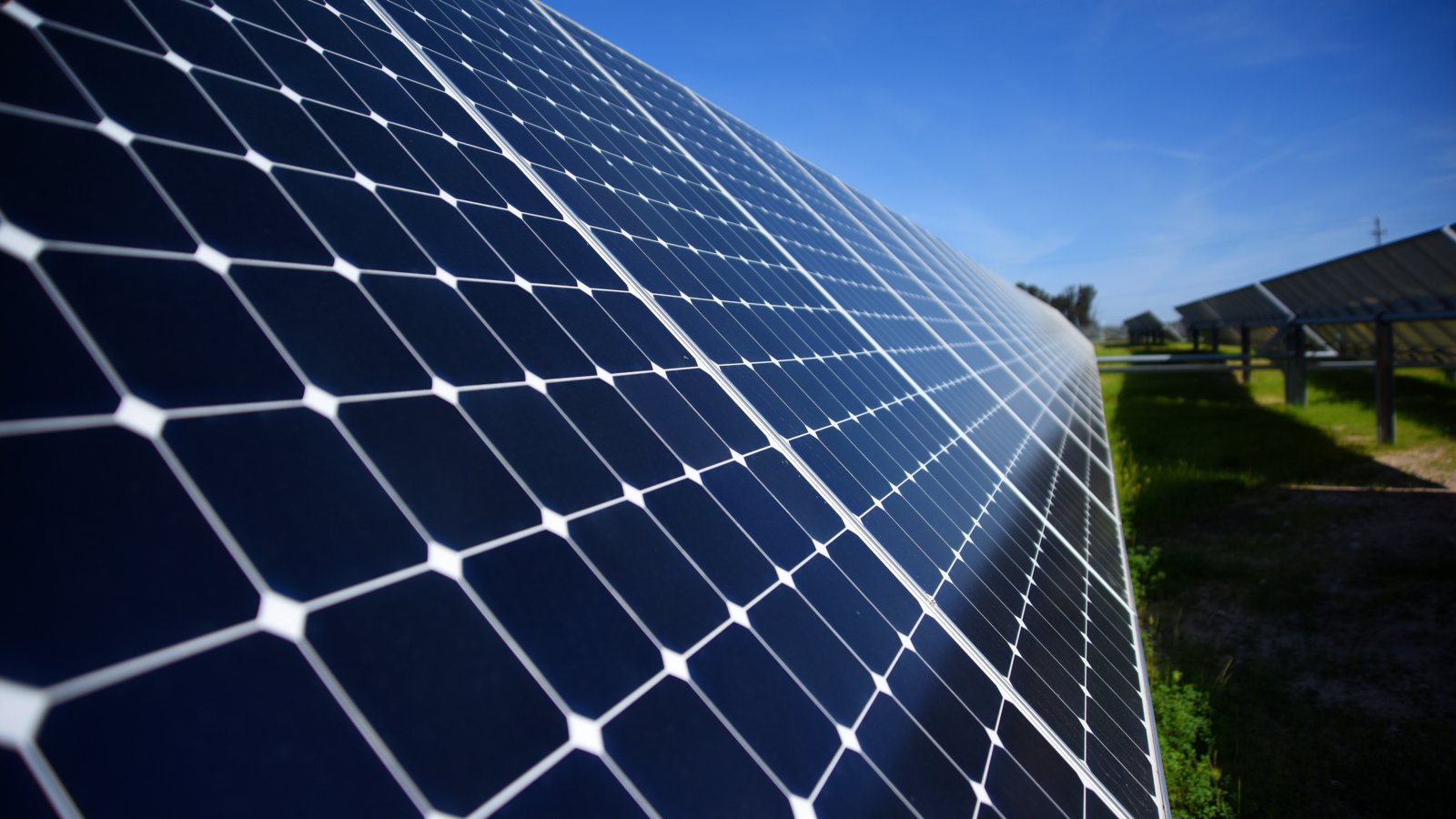
The 28 megawatt solar array at Vandenberg Air Force Base, Calif., dedicated April 10, 2018. Photo: Senior Airman Clayton Wear, U.S. Air Force, public domain, via Wikimedia Commons.
DOE's Energy Saver guidance for stand alone systems: use deep cycle batteries, never car batteries. They typically last 5 to 10 years and can discharge about 80 percent of their capacity. Size them for cloudy stretches, and keep them in a ventilated space isolated from living areas, because they can release hydrogen while charging.
Heat without the grid
A wood stove is the oldest backup. EPA Burn Wise says burn only dry, split, seasoned wood with moisture under 20 percent, season it at least six months, and store it outdoors off the ground with only the top covered.
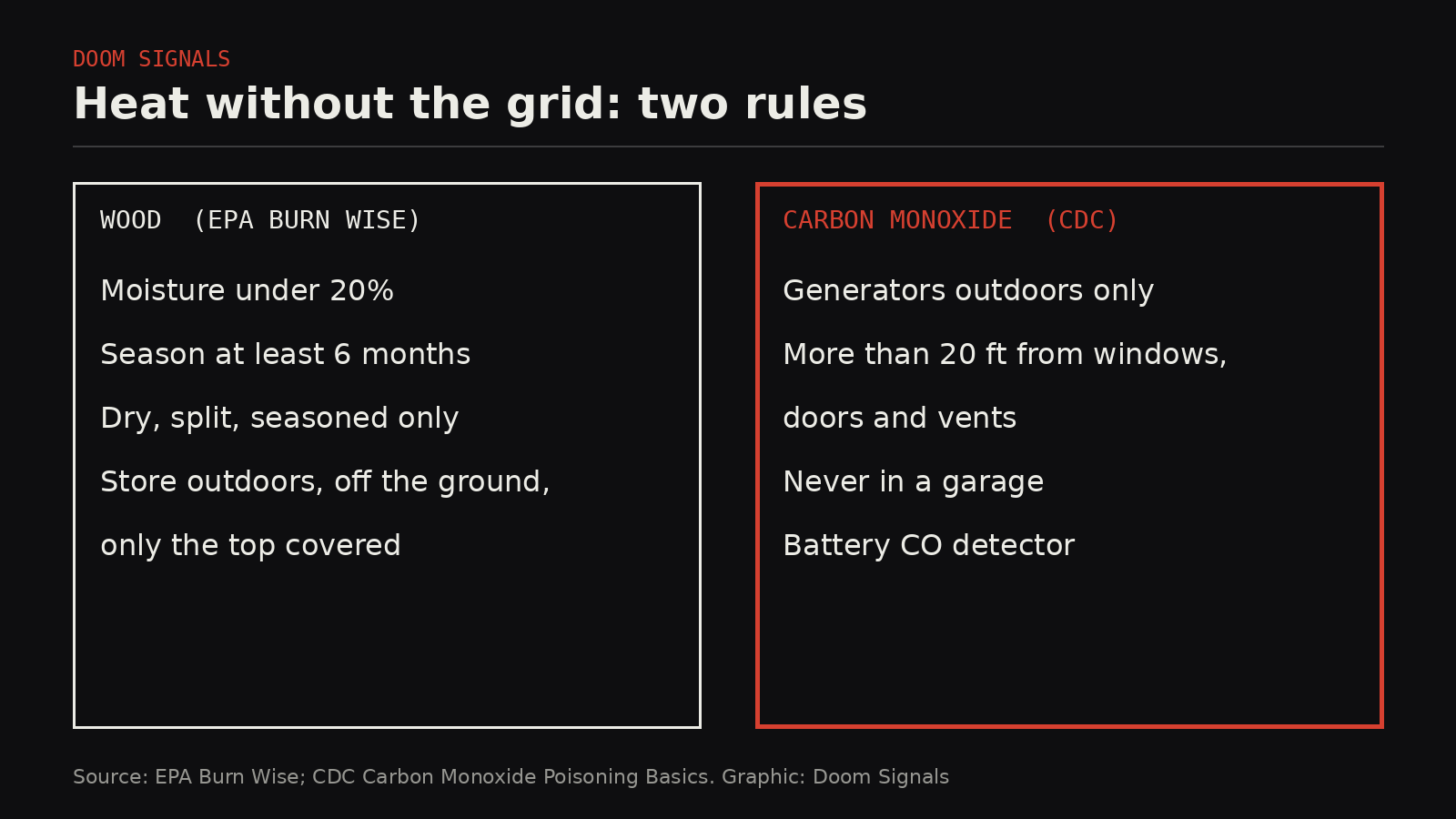
Heat and carbon monoxide rules from EPA Burn Wise and CDC. Graphic: Doom Signals.
The one CDC rule worth taping to the door: carbon monoxide kills quietly. Run generators outdoors, more than 20 feet from windows, doors and vents, never in a garage, and keep a battery powered or battery backup CO detector.
Medicine without refrigeration
FDA says insulin is normally kept at 36°F to 46°F, but opened or unopened vials and cartridges can be kept between 59°F and 86°F for up to 28 days. In an emergency, insulin stored above 86°F may still need to be used. Ask your doctor and pharmacist now about extra supply and any other medicine that needs cold storage.
The American Red Cross teaches Wilderness and Remote First Aid for situations where help is delayed, including urban disasters. In a long outage, an ambulance may be one of them.
Community and security
No household holds out alone for long. The sources above assume shared work: someone grinds grain, someone treats water, someone keeps the latrine clean. Know your neighbors, pool skills and tools, agree on how you check on each other, and keep your stores out of sight. Quiet preparation draws less attention than a full garage.
The calm takeaway
The Pentagon is planning to stand apart from the grid. Nobody official is predicting a 90 day blackout. But the gap between a few days of preparation and a few months is mostly dry food, treated water, a latrine plan, seasoned wood and a conversation with your pharmacist.
Follow the live official signals on our monitor, see how we source and verify in our methodology, and read our related guide, Geomagnetic storm warning today: how to check NOAA.
Sources
- Department of War, Establishment of FORTRESS America as a Department of War Program for the Defense of the American Homeland, memo of Sept 30, 2026
- Department of War, Secretary of War Pete Hegseth's State of the Force Address (As Delivered), Sept 30, 2026 (via Public)
- Fox News Digital, Pentagon's FORTRESS initiative preps US bases for 90 day survival, Oct 25, 2026
- Air & Space Forces Magazine, Pentagon Starting with Resilient Energy for FORTRESS America
- US Army, Army Directive 2020-03, Installation Energy and Water Resilience Policy
- US Code, 10 U.S.C. 2920
- The Church of Jesus Christ of Latter-day Saints, Longer-Term Food Supply
- BYU Nutrition, Dietetics and Food Science, An Approach to Longer-Term Food Storage, June 2024
- BYU study via PubMed, Sensory quality of long term stored wheat and rice
- USU Extension, Storing Water for an Emergency and 7 Factors That Prolong Your Food Storage Supply
- USDA and National Center for Home Food Preservation, For Safety's Sake
- EPA, Emergency Disinfection of Drinking Water
- Texas A&M AgriLife Extension, Rainwater Harvesting: Drinking Water Treatment
- Mississippi State University Extension, P3398, Disinfecting a Water Well through Shock Chlorination
- US Army, ATP 4-25.12, Unit Field Sanitation Team
- US Army, FM 21-76, Survival, chapter 6, Water Procurement
- Department of Energy, Solar and Resilience Basics
- NREL, technical report 75704 on solar plus storage for resilience
- Department of Energy, Balance of System Equipment Required for Renewable Energy Systems
- EPA Burn Wise, Best Wood Burning Practices
- CDC, Carbon Monoxide Poisoning Basics
- FDA, Information Regarding Insulin Storage and Switching Between Products in an Emergency
- American Red Cross, Wilderness and Remote First Aid
- Hero image and graphics: Doom Signals, built from the sources above
- Photos: U.S. Army (Spc. Robert Porter), U.S. Air Force (Senior Airman Clayton Wear) and National Archives, all public domain, via Wikimedia Commons