
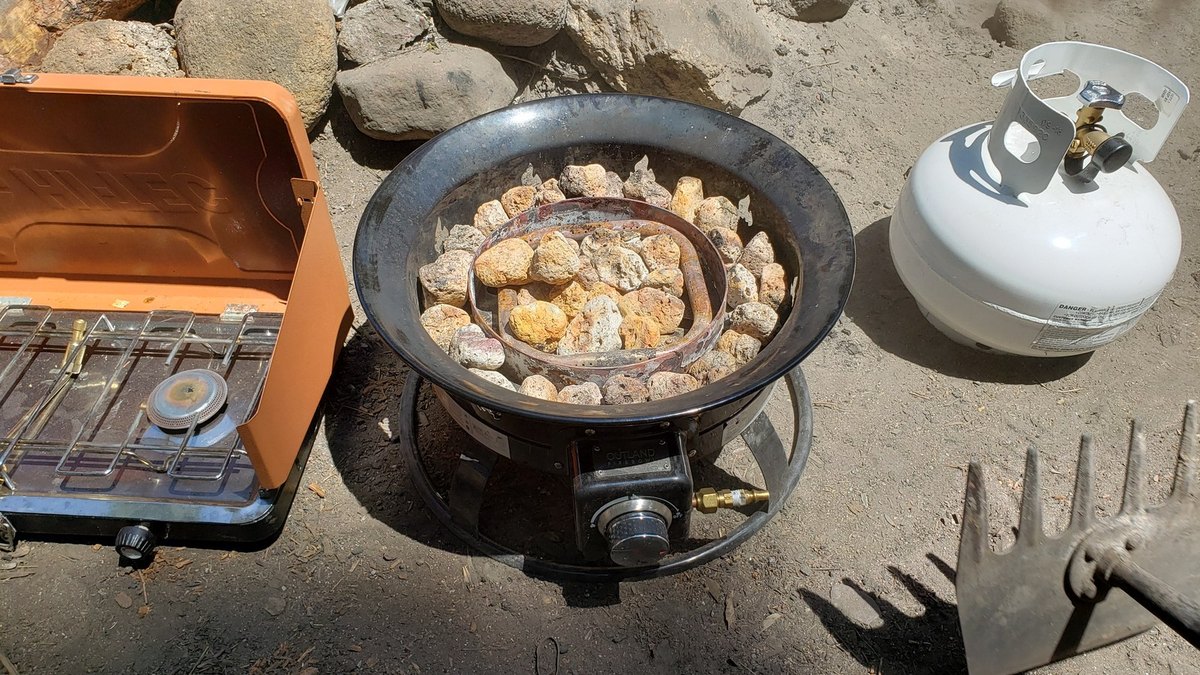
Cook on grills, camp stoves and portable gas stoves outdoors only, because they make carbon monoxide. FEMA says to keep them at least 20 feet from windows, and University of Minnesota Extension says to keep a gas grill at least 10 feet from any building. Never use a gas stovetop or oven to heat your home. Or skip cooking: eat food that needs no refrigeration, cooking or water, and open cans with a manual can opener. That advice comes from FEMA, the Environmental Protection Agency (EPA), Ready.gov and University of Minnesota Extension.
Guidance checked Sunday, Nov 22, 2026, 11:20 AM ET.
Some links on this page are affiliate links. If you buy through them, Doom Signals may earn a small commission at no extra cost to you. We only list gear that meets the safety and spec rules on this page. As an Amazon Associate, Doom Signals earns from qualifying purchases.
Quick answers
- Grills, camp stoves and portable gas stoves go outdoors only (FEMA, CDC, EPA).
- How far from the house depends on the source: FEMA says at least 20 feet from windows, and UMN Extension says at least 10 feet from any building for a gas grill.
- Never use a gas stove or oven to heat your home (Ready.gov, EPA).
- Never burn charcoal indoors, including in a fireplace (CDC, EPA).
- Canned food can be eaten straight from the can, and a manual can opener belongs in your kit (Ready.gov).
- Cook meat to a safe temperature, checked with a food thermometer (USDA, UMN Extension).
- If the power goes out on Thanksgiving, a thawing or partly cooked turkey follows USDA temperature rules; cook only on a grill outdoors, never indoors or in a garage.
- Keep a carbon monoxide alarm with battery backup working (EPA).
For everything else to do when the lights go out, start with our what to do during a power outage checklist.
The one rule: fuel-burning cooking goes outside
FEMA's answer on safe cooking in an outage is short. "Use a portable gas stove or grill outdoors only," and "Use a camping stove or other portable cooking devices outdoors only." It warns that charcoal grills "produce large amounts of carbon monoxide, which can result in death or serious illness."
Other official sources say the same in their own words. The CDC says, "Never use a portable gas camp stove indoors," and "Never burn charcoal indoors." The EPA says not to use unvented combustion appliances such as barbecues, hibachis or camp stoves indoors, because they "produce toxic fumes, including carbon monoxide (CO)." Oregon State University Extension says cooking equipment made for outdoor use "cannot be used indoors or in attached garages."
That rules out an attached garage too. The EPA calls carbon monoxide an invisible and odorless gas and says it "can build up quickly indoors and can linger for hours." Our generator distance guide covers carbon monoxide symptoms and alarms.
How far from the house
The sources measure distance in different ways, so each one is here in its own words:
- FEMA: "use stoves and grills outdoors and at least 20 feet from windows."
- Ready.gov: generators, camp stoves and charcoal grills "should always be used outdoors and at least 20 feet away from windows."
- University of Minnesota Extension: for a gas grill, "Use grills outdoors only and at least 10 feet away from any building."
- EPA: cook outdoors "at a safe distance away from your home's doors, windows and any air intakes for your home's HVAC system," with no number.
The 20 feet is measured from windows and the 10 feet from any building, so the figures don't measure the same thing. Your grill or stove maker's manual may give its own clearance too.
UMN Extension adds a fire warning for camp stoves. Propane and butane fires "are difficult to extinguish," it says, and "There is little you can do to put out a propane or butane fire except shut off the gas. Learn where the shut-off valve is before lighting a camp stove."
Gas stovetop in an outage
Never use it for heat. Ready.gov says, "Never use a gas stovetop or oven to heat your home," and the EPA says not to heat your home with combustion appliances "including gas stoves or ovens, barbeque grills or dryers."
Cooking on it is a question for your range's manual. Range makers say a gas oven typically can't be lit without power, but some cooktop burners can be lit with a match:
- GE Appliances: on an electric ignition gas cooktop or range, "you can light the surface burners" with a match. Hold a lighted match next to the burner, "then turn the knob to the low position." It says the oven "cannot be manually lit when there is a power outage."
- Whirlpool: hold a match near the burner and turn the knob to "IGNITE/Lite," but it says some stoves have "a safety feature that prevents it" and to check your model's manual first. It adds that your manual may tell you not to use grills or griddles, "since your vent may not be working."
GE warns that gas keeps flowing to a burner that has gone out, and says, "For safety, make sure the burner stays lit, or you turn the burner to Off." The EPA also says opening windows slightly can help, and that ventilation matters "especially" while cooking. If you aren't sure your range allows it, check the manual or ask your gas utility before you try.
No-cook meals
Skip the stove when you can. Ready.gov says to stock "canned foods, dry mixes and other staples that do not require refrigeration, cooking, water or special preparation," and to "include a manual can opener and eating utensils." It also says, "Commercially canned food may be eaten out of the can without warming."
University of Minnesota Extension suggests peanut butter sandwiches, crackers with canned meat or fish, fresh fruit in the peel, and unopened cans of fruit or pudding. It says to throw out extra canned food that has been opened.
Eat in the right order: fridge food first, then freezer, then shelf food. Our guide to how long food lasts in the fridge without power has the time and temperature rules for what to keep and what to toss.
Indoor options and their limits
This is where official advice splits. Some sources name indoor options, and the EPA rules out anything unvented. Each is here in its own words, and none of them makes a fuel safe in every home:
- FEMA and Ready.gov: "Alternative cooking sources can be used in times of emergency including candle warmers, chafing dishes, fondue pots or a fireplace."
- University of Minnesota Extension: a fondue pot or chafing dish can be used inside "as long as the fuel heating them is approved for indoor use." In a fireplace, be sure the flue is open, and never use charcoal.
- Oregon State University Extension: most portable cooking stoves "cannot be safely used indoors," though those using butane fuel "can be used with proper ventilation," following the maker's directions.
- EPA: "Unvented combustion appliances should not be used to cook indoors, or for any other indoor use." It says vented appliances, such as a vented fireplace or wood stove set up for cooking, can be used "if the vent does not require power to operate."
- CDC: "Never use a portable gas camp stove indoors."
The EPA's line is the strictest, and the CDC's is the plainest about camp stoves. UMN Extension's condition for a fondue pot or chafing dish is fuel approved for indoor use, and the EPA says to make sure your home has working carbon monoxide alarms. The EPA also says to never use charcoal in a fireplace.
Boiling water without power
If you need to boil water, do it outdoors on a grill or camp stove. The CDC says to bring water to a full rolling boil for 1 minute, and longer at high elevations. Our boil water advisory guide has the altitude figures from the CDC and the EPA side by side.
Food safety while cooking
Use a food thermometer. The USDA says to cook food to safe minimum internal temperatures "as measured with a food thermometer, before removing food from the heat source." Its chart lists:
- Ground meats: 160°F.
- All poultry: 165°F.
- Beef, pork, veal and lamb steaks, chops and roasts: 145°F, then rest at least 3 minutes.
- Fish and shellfish: 145°F.
- Leftovers: 165°F.
University of Minnesota Extension gives the same 160°F for ground beef and 165°F for poultry. If fuel is short, it says to choose food that cooks quickly, or food you don't have to cook. Cook only what you need for one meal, it says, because milk, cooked meat, soups, pasta and vegetables left at room temperature for more than two hours "provide excellent conditions for growth of disease causing organisms."
Keep things clean. UMN Extension says to wash your hands with soap and warm water for 20 seconds before and after handling food, using bottled water and soap if there is no running water, and to wash cutting boards, dishes, knives and counters with hot, soapy water after each food item.
If the power goes out on Thanksgiving
If the oven dies mid-turkey, or the bird is still thawing, use the USDA temperature rules. FoodSafety.gov, citing USDA, says never taste food to decide whether it is safe, and "When in Doubt, Throw it Out."
A turkey that is still thawing should be discarded if it has been at 40°F or above for more than 2 hours, according to FoodSafety.gov's power-outage chart, which lists "Thawing meat or poultry" under discard. The same chart, and USDA guidance quoted there, say a closed refrigerator keeps food safe for up to 4 hours; after 4 hours without power, discard refrigerated perishable food such as meat, poultry, fish, eggs, and leftovers. FoodSafety.gov also says that if the food still contains ice crystals, or is at 40°F or below, it may be safely refrozen or cooked, though quality may suffer. FSIS lists cooking a turkey from frozen as an option, with about 50% more cooking time, and the turkey must still reach a safe internal temperature.
A turkey that is only partly cooked should not sit and be finished later. FSIS's Kitchen Companion says interrupted cooking "allows partially cooked food to cool down . . . and may encourage bacterial growth before cooking is complete," and tells cooks to "make sure to cook food all the way through the first time." If you finish the bird on a grill, that handbook says the food must go immediately onto a preheated grill, and "Never partially grill meat or poultry and finish cooking it later." FoodSafety.gov's chart says to discard raw or leftover cooked poultry that has been at 40°F or above for more than 2 hours. Its emergency page adds the same 2-hour rule, or 1 hour if the air is above 90°F. If the turkey is still in a safe temperature range and you can finish it right away, FSIS's "Turkey: Alternate Routes to the Table" notes that a power outage is one reason to change cooking methods, and it names an outdoor covered gas or charcoal grill as a way to cook a turkey safely.
Cook only on a grill outdoors. Never cook on a grill indoors or in a garage, even an attached garage with the door open. The sources already on this page say the same: FEMA says to use a grill "outdoors only," the CDC says never to burn charcoal indoors, and Oregon State University Extension says cooking equipment made for outdoor use "cannot be used indoors or in attached garages." Use a food thermometer. FSIS says a whole turkey is safely cooked only when it reaches a minimum of 165°F in the thickest part of the breast, the innermost part of the thigh, and the innermost part of the wing.
If you cannot finish the turkey safely, shift the meal to no-cook sides. University of Minnesota Extension, already cited above, suggests peanut butter sandwiches, crackers with canned meat or fish, fresh fruit in the peel, and unopened cans of fruit or pudding. Ready.gov says commercially canned food may be eaten out of the can, and FoodSafety.gov's chart lists uncut fresh fruit, uncut fresh vegetables, hard cheeses, peanut butter, and bread or rolls as foods you can keep even after they have been above 40°F for more than 2 hours.
Gear that helps
What to look for: a manual can opener (Ready.gov), a carbon monoxide alarm with a digital display and battery backup (EPA) listed to UL 2034, a food thermometer (USDA) and, for outdoor cooking only, a camp stove (FEMA). We list no indoor stove, heater or fuel.
Doom Signals earns from qualifying Amazon purchases.
Kidde COPD plug-in CO alarm with battery backup and display
Kidde says this alarm is tested to meet UL 2034 5th Edition and uses a 120-volt plug with two AA backup batteries, so it keeps working when the outlet is dead. A backlit display shows CO levels. The EPA says CO alarms should have a digital display and battery backup.
Checked Wednesday, Nov 18, 2026, 8:35 AM ET. No prices listed because they change daily.
More outage gear is in our power outage kit list.
FAQ
- How can I cook when the power is out?
- Use a grill, camp stove or portable gas stove outdoors only, or eat no-cook food (FEMA, Ready.gov).
- How far from the house should a grill be?
- FEMA says stoves and grills should be at least 20 feet from windows. UMN Extension says gas grills at least 10 feet from any building.
- Can I grill in the garage or on a covered porch?
- Not in a garage: Oregon State Extension says outdoor cooking equipment cannot be used indoors or in attached garages. No source we found names covered porches, but the EPA says to cook outdoors at a safe distance from doors, windows and air intakes.
- Can I use my gas stove during a power outage?
- Ready.gov says never use a gas stovetop or oven to heat your home. For cooking on it, check your range manual: some makers say burners can be lit with a match, and some models block it (GE Appliances, Whirlpool).
- Can I use a camp stove inside?
- The CDC and FEMA say no. UMN Extension allows fondue pots and chafing dishes indoors only with fuel approved for indoor use, and the EPA says no unvented combustion appliance should be used to cook indoors.
- What can I eat without cooking?
- Ready.gov suggests foods that need no refrigeration, cooking or water, plus a manual can opener. Canned food can be eaten from the can without warming.
- How do I boil water without power?
- On a grill or camp stove outdoors. The CDC says a full rolling boil for 1 minute (see our boil water guide).
- Do I need a carbon monoxide alarm?
- Yes. The EPA says to make sure your home has working CO alarms with a digital display and battery backup.
More outage gear is in our power outage kit list.
### FAQ
How can I cook when the power is out? Use a grill, camp stove or portable gas stove outdoors only, or eat no-cook food (FEMA, Ready.gov).
How far from the house should a grill be? FEMA says stoves and grills should be at least 20 feet from windows. UMN Extension says gas grills at least 10 feet from any building.
Can I grill in the garage or on a covered porch? Not in a garage: Oregon State Extension says outdoor cooking equipment cannot be used indoors or in attached garages. No source we found names covered porches, but the EPA says to cook outdoors at a safe distance from doors, windows and air intakes.
Can I use my gas stove during a power outage? Ready.gov says never use a gas stovetop or oven to heat your home. For cooking on it, check your range manual: some makers say burners can be lit with a match, and some models block it (GE Appliances, Whirlpool).
Can I use a camp stove inside? The CDC and FEMA say no. UMN Extension allows fondue pots and chafing dishes indoors only with fuel approved for indoor use, and the EPA says no unvented combustion appliance should be used to cook indoors.
What can I eat without cooking? Ready.gov suggests foods that need no refrigeration, cooking or water, plus a manual can opener. Canned food can be eaten from the can without warming.
How do I boil water without power? On a grill or camp stove outdoors. The CDC says a full rolling boil for 1 minute (see our boil water guide).
Do I need a carbon monoxide alarm? Yes. The EPA says to make sure your home has working CO alarms with a digital display and battery backup.
More outage guides: what to do during a power outage, how to stay warm during a winter power outage, which explains why the stove is never a heater, and how to prepare for a 90 day power outage. All of them are on our guides page. To get the next guide by email, subscribe here. How we pick and check sources is on our methodology page.
Sources
- FEMA, What are safe cooking methods to use during a power outage? (last updated June 23, 2025)
- University of Minnesota Extension, Preparing food without power (reviewed 2021)
- Oregon State University Extension Service, EM 9278, Survival Basics: No Power? No Problem
- EPA, Power Outages and Indoor Air Quality (last updated Feb. 18, 2026)
- CDC, Carbon Monoxide (CO) Poisoning Basics and Drinking Water Advisories: An Overview
- Ready.gov, Food and Power Outages
- USDA Food Safety and Inspection Service, Safe Minimum Internal Temperature Chart
- FoodSafety.gov, Food Safety During Power Outage
- FoodSafety.gov, Food Safety in a Disaster or Emergency
- USDA Food Safety and Inspection Service, Your Safe Thanksgiving Guide, Turkey Basics: Safe Cooking, and Turkey: Alternate Routes to the Table
- USDA Food Safety and Inspection Service, Kitchen Companion: Your Safe Food Handbook (PDF, slightly revised March 2015)
- GE Appliances, Lighting Electric Ignition Burners During a Power Failure, and Whirlpool, Will a Gas Stove Work in a Power Outage?
- Maker: Kidde COPD
Image: U.S. Forest Service, Pacific Southwest Region (public domain).
All guidance checked Sunday, Nov 22, 2026, 11:20 AM ET.