
Charge your phone, laptop or tablet before a storm, and keep a charged power bank and a car charger on hand. Once the power is out, dim the screen, close apps you aren't using, switch to airplane mode and keep calls short. Recharge from a power bank, from a laptop with a USB cable, or from a car charger. If the car has to run, keep it in a well-ventilated place and never inside a garage attached to your house, even with the door open. That advice comes from the Department of Energy (DOE), the Federal Communications Commission (FCC) and the CDC.

Guidance checked Sunday, Nov 22, 2026, 11:20 AM ET.
Some links on this page are affiliate links. If you buy through them, Doom Signals may earn a small commission at no extra cost to you. We only list gear that meets the safety and spec rules on this page. As an Amazon Associate, Doom Signals earns from qualifying purchases.
Quick answers
- Charge before the storm. The FCC says to charge your cell phone, laptop or tablet if a storm is coming.
- Save battery. The DOE says to dim the screen, use airplane mode and close apps you aren't using.
- Recharge without wall power from a power bank, a laptop with a USB cable or a car charger (FCC, DOE).
- Run the car only in a well-ventilated place (DOE), and never in an attached garage (CDC).
- Text instead of calling when it isn't an emergency (FCC).
- When the power comes back, unplug electronics first, because power can return with surges (Ready.gov).
- For a power bank, look for a UL 2056 listing, UL's safety standard for power banks.
If the lights just went out, start with our what to do during a power outage checklist, then come back here for the phone.
Before the outage: charge everything
The FCC and FEMA put it simply in their joint emergency tips: "Charge your cell phone, laptop, or tablet if a storm is coming." The same page says to consider keeping extra batteries, a solar charger or a car charger on hand. The Department of Energy says to "Keep spare batteries and a car charger for your phone," and Ready.gov's basic emergency kit list includes a "Cell phone with chargers and a backup battery."
A charged laptop or tablet counts as a spare battery too, because it can top up a phone later. Ready.gov also says to plan for batteries and other power sources "such as a portable charger or power bank," and to find out whether your home phone will work in an outage. The FCC says phone service that runs over broadband "will not work during electric outages without a battery or other backup power source," while a traditional copper landline may still work with a corded phone.
Make the battery last
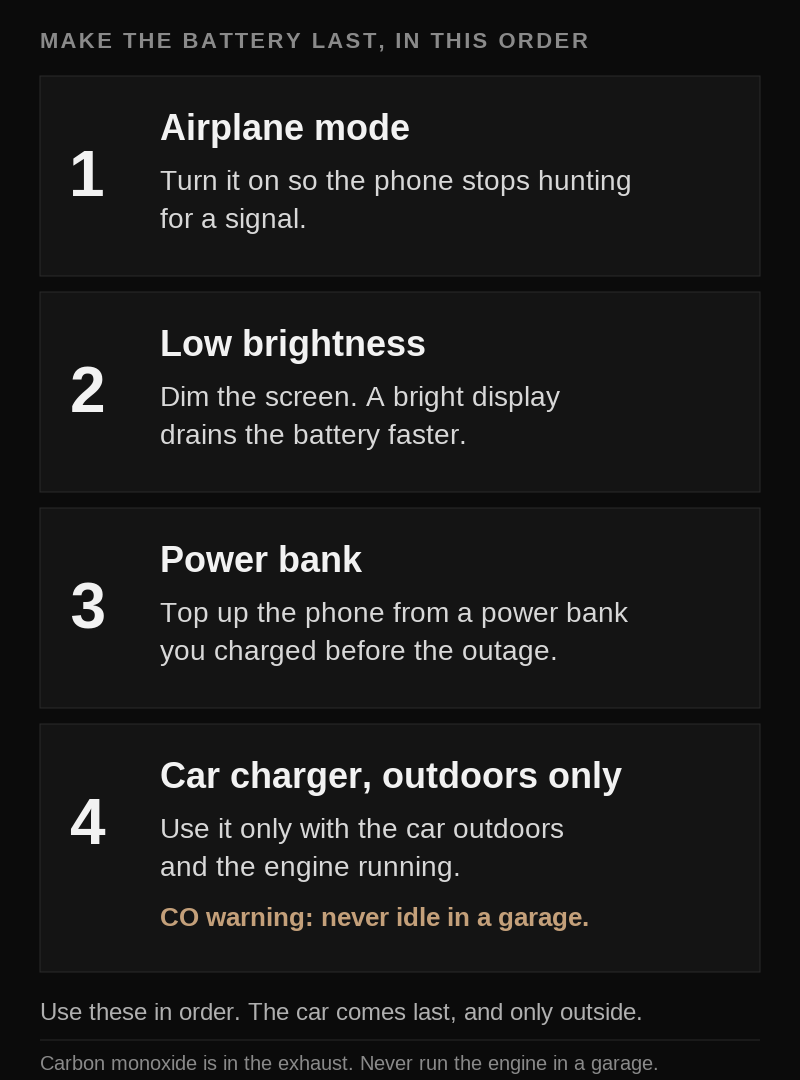
The Department of Energy says to "Reduce the brightness of your screen, place your phone in airplane mode, and close apps you are not using to minimize drain on your battery." It also says to keep all phone calls brief and stick to vital information.
The FCC adds two habits. For anything that isn't an emergency, text instead of calling, because a text "may go through when your call may not." And if a call fails, wait 10 seconds before you redial, since rapid redialing clogs the network for everyone.
The two agencies handle a weak signal a little differently:
- DOE: put the phone in airplane mode to save battery.
- FCC: if the network in your area is damaged and you see no signal bars, "turning your phone off helps prevent the battery from draining as your phone seeks a usable wireless signal."
Both point the same way. A phone hunting for a signal burns battery, so cut it off from the network when you don't need it, and check in at set times instead.
Ways to recharge without wall power
- Power bank. Charge it fully before the storm, then use it to top up your phone. Ready.gov names a portable charger or power bank as a backup power source.
- Laptop or tablet. The FCC says you can recharge your phone from a charged laptop or tablet with a USB cable, "though doing so may drain your computer's battery power."
- Car charger. The DOE and the FCC both list a car charger. Read the next section before you start the engine.
- Crank or solar radio. The FCC says some solar or hand-cranked radios can also charge cell phones, but check the instruction manual first. Midland, the maker of the radio we list below, says its solar panel isn't meant to charge a drained battery, only to extend a full one, so charge it by cable before the storm.
- Power station. For bigger loads, like a laptop for days or a medical device, see our power station vs generator comparison. The current top pick on our apartment power station page is the EcoFlow RIVER 2 Pro.
Doom Signals earns from qualifying Amazon purchases.
EcoFlow states this station at 768Wh, 800W rated output, and X-Boost 1600W. It is the top pick on our page for a fridge or CPAP power station in an apartment. We did not measure a fridge or a CPAP on it.
Charging in the car safely
Cars burn fuel, and the CDC says carbon monoxide is in the fumes "any time you burn fuel in cars or trucks." The sources word the car rule differently, so each one is here in its own words:
- Department of Energy: if your car must be running to charge the phone, "be sure your car is in a well-ventilated place. Removing your car from the garage before charging, once danger has passed, is the safest option."
- CDC: "Never run your car or truck inside a garage that is attached to a house, even with the garage door open." For a detached garage, it says to always open the door to let in fresh air.
- FCC: don't try to reach your car if it isn't safe, and "remain vigilant about carbon monoxide emissions from your car, especially if it is in a closed space."
Put together, the safest choice is the DOE's: back the car out of the garage, once it is safe to go outside, before you charge. Never idle in an attached garage, the CDC says, even with the big door up. While you wait, the DOE notes you can listen to the car radio for news.
Keep a carbon monoxide alarm working inside too. The CDC says to install battery-operated or battery backup CO detectors near every sleeping area, and Ready.gov says to put detectors with battery backup in central locations on every level of your home. Our generator distance guide covers carbon monoxide from engines in more depth. If you need to power a CPAP, see how to run a CPAP during a power outage.
When the power comes back
Ready.gov says to turn off or disconnect appliances, equipment and electronics during an outage, because "Power may return with momentary surges or spikes that can cause damage." That includes chargers plugged into the wall. Unplug them while the power is out, and plug them back in once it is steady.
No official source we found says a phone left plugged in will be damaged. Ready.gov's advice to unplug is the one to follow.
What to look for in a power bank
Look for a UL 2056 listing. UL Standards & Engagement publishes UL 2056 as its standard for power banks, which it describes as "portable USB chargers or portable back-up battery power." It says the requirements "are intended to reduce the risk of fire or explosion of power banks," and they cover power banks up to 100 watt hours. Bigger portable power packs fall under a different standard, UL 2743.
Check the capacity on the label or the maker's page, and charge it fully before storm season. Makers often say how many phone charges a power bank holds, but that depends on the phone, so treat any number of charges as the maker's estimate.
Gear that helps
What to look for: a power bank listed to UL 2056 (UL Standards & Engagement), a car charger and spare cable (DOE, FCC) and a radio that can charge a phone (FCC).
Doom Signals earns from qualifying Amazon purchases.
Clutch says it is "UL 2056 Certified" and lists a 5000mAh battery with a built-in USB-C charging cable, so there is no separate cable to forget. It fits USB-C phones only.
Anker lists this as a 12-volt cigarette lighter USB-C car charger, with a USB-A port as well. Both the DOE and the FCC say to keep a car charger for your phone. Use it only with the car outdoors and the engine running, as this guide describes.
Checked Sunday, Nov 22, 2026, 11:20 AM ET. No prices listed because they change daily.
The rest of the list is in our power outage kit list.
FAQ
- How do I charge my phone during a power outage?
- Use a charged power bank, a laptop with a USB cable or a car charger. If the car must run, keep it in a well-ventilated place and never in an attached garage (DOE, FCC, CDC).
- How do I keep a phone charged without power?
- Charge it fully before a storm, then save battery: lower the brightness, close apps you aren't using and use airplane mode (DOE, FCC).
- Is it bad to leave my phone plugged in when the power goes out?
- Ready.gov says to turn off or disconnect electronics, because "power may return with momentary surges or spikes that can cause damage."
- How do I save phone battery during a power outage?
- Dim the screen, close unused apps, switch to airplane mode and keep calls short (DOE). Text instead of calling when you can (FCC).
- Can I charge my phone in the car?
- Yes, with a car charger. If the engine has to run, keep the car in a well-ventilated place, and once it is safe, move it out of the garage first (DOE). Never run it in an attached garage, even with the door open (CDC).
- Will a laptop charge my phone?
- Yes, with a USB cable, but it may drain the laptop's battery (FCC).
- What should I look for in a power bank?
- A UL 2056 listing, UL's safety standard for power banks, and its capacity on the label (UL Standards & Engagement). Ready.gov's basic kit list includes a "Cell phone with chargers and a backup battery."
- Should I charge devices before a storm?
- Yes. The FCC says to charge your cell phone, laptop or tablet if a storm is coming.
More outage guides: what to do during a power outage, how to stay warm during a winter power outage, how long food lasts in the fridge without power and how to store water for emergencies. All of them are on our guides page. To get the next guide by email, subscribe here. How we pick and check sources is on our methodology page.
Sources
- U.S. Department of Energy, Office of Cybersecurity, Energy Security, and Emergency Response, Keeping Mobile Devices Charged (last updated Sept. 16, 2019)
- FCC and FEMA, Emergency Communications Tips (reviewed May 1, 2026)
- FCC, Tips for Communicating in an Emergency
- CDC, Carbon Monoxide (CO) Poisoning Basics
- Ready.gov, Power Outages and Build A Kit
- UL Standards & Engagement, UL 2056, Power Banks
- Makers: Clutch Pro USB-C
Image: Federal Communications Commission (public domain).
All guidance checked Saturday, Nov 14, 2026, 12:45 AM ET.