
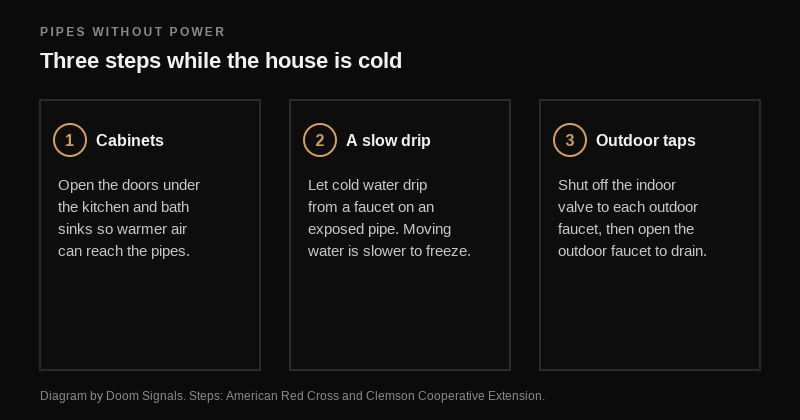
When the heat is out, the pipes most likely to freeze are the ones in unheated places: crawl spaces, attics, garages, and the cabinets under kitchen and bathroom sinks, plus pipes that run along exterior walls. The American Red Cross explains why that matters: water expands as it freezes and can break a pipe.
How cold before pipes freeze
A pipe freezes when the water inside it stays cold long enough to turn to ice. Clemson Cooperative Extension says it can take only a few hours of temperatures below 25°F. The Red Cross notes that pipes in unheated interior areas and along poorly insulated exterior walls freeze first. There is no single indoor thermostat number that covers every house, so treat a cold, unheated house as a pipe risk and start the steps above early.
If you're on a well
A well pump needs power to move water. If the power is out, the pump stops, and water already in the pipes can still freeze.
The Water Systems Council says most well pumps sit deep enough that they do not freeze, so the parts you protect are the well casing above ground and the pipes. It says an above-ground pump should be kept where the temperature stays above 40°F. If that area can drop below 32°F, the pump should be in an insulated enclosure. Clemson Cooperative Extension says well parts outside a pump house should be covered with a sturdy insulated box or a manufactured well-pump cover, and not with a heat lamp, which can be a fire hazard. Pressure gauges, it says, freeze easily. For help with a pump house or a pitless adapter (a frost-proof fitting below the frost line), the Water Systems Council says to call a licensed well contractor.
If you use a generator to run the pump, it has to stay outdoors only, at least 20 feet from doors, windows and vents, with the exhaust pointed away from the house. See how far a generator should be from the house. You can check a battery station against the watts on your pump's label with the power station size calculator. If the well or the pipes freeze, call a licensed well contractor or plumber (Water Systems Council).
How to thaw a frozen pipe safely
If a faucet gives only a trickle, the Red Cross says to suspect a frozen pipe, often along an exterior wall or where the water line enters the house. Keep that faucet open. As ice melts, running water helps clear the rest of the pipe.
The Red Cross says you can apply heat with towels soaked in hot water, or, if you have power, with an electric heating pad, a hair dryer, or a portable space heater kept away from anything that can burn. Do not use a blowtorch, a kerosene or propane heater, a charcoal stove, or any other open flame. Those can start a fire or fill the room with carbon monoxide.
If you cannot find the frozen section, cannot reach it, or cannot thaw it, call a licensed plumber.
When to call a plumber
Call a licensed plumber if you cannot thaw a pipe, if you cannot reach the frozen section, or if a pipe bursts. Clemson University Facilities advice is to shut off water at the main valve if a pipe bursts, then open a low faucet to drain, and to call a professional for the repair. The Red Cross also says that if one pipe freezes, others may too, so check the other faucets. Know where your main shutoff is before the next cold night (Clemson).
For staying warm while you wait, see how to stay warm without power in winter. If a basement starts to take on water after pipes thaw, see how to run a sump pump during a power outage.
FAQ
Should I let a faucet drip if the power is out?
Yes, if pipes in unheated cabinets or along exterior walls could freeze. The American Red Cross says to let cold water drip from the faucet served by exposed pipes, because even a trickle helps keep the pipe from freezing. Clemson Cooperative Extension says to let one or two faucets drip during a short cold snap.
How do I thaw a frozen pipe without power?
The American Red Cross says to keep the faucet open and apply heat with towels soaked in hot water. Do not use a blowtorch, kerosene or propane heater, charcoal, or any open flame. An electric heating pad, hair dryer, or space heater only works if you have power or a safe indoor-rated source. If you cannot find or reach the frozen section, call a licensed plumber.
What if I'm on a well?
A well pump needs power to run. The Water Systems Council says an above-ground pump should be kept where the temperature stays above 40°F, and that if the area can drop below 32°F the pump should be in an insulated enclosure. Any generator you use has to run outdoors only, at least 20 feet from doors, windows and vents. If the well or pipes freeze, call a licensed well contractor or plumber.
Sources
- American Red Cross, Preventing and Thawing Frozen Pipes
- Ready.gov, Winter Weather
- Clemson Cooperative Extension, Becky Davis, Winter is Coming! Insulate Your Water Pipes! (Nov 15, 2023)
- Water Systems Council, Winterizing and Protecting Pipes
- Clemson University Facilities, in Clemson News, How to prevent frozen pipes and stay warm during a power outage (Jan 30, 2026), used for the burst-pipe shutoff and the advice to locate the main valve before a freeze
- CPSC, CDC, NFPA and Ready.gov, as cited on How far should a generator be from the house, for keeping a generator outdoors and at least 20 feet from doors, windows and vents
Image: diagram by Doom Signals, based on the Red Cross and Clemson Cooperative Extension steps listed above.
All guidance checked Thursday, Nov 26, 2026, 5:15 PM ET.
Checked Thursday, Nov 26, 2026, 5:15 PM ET.