
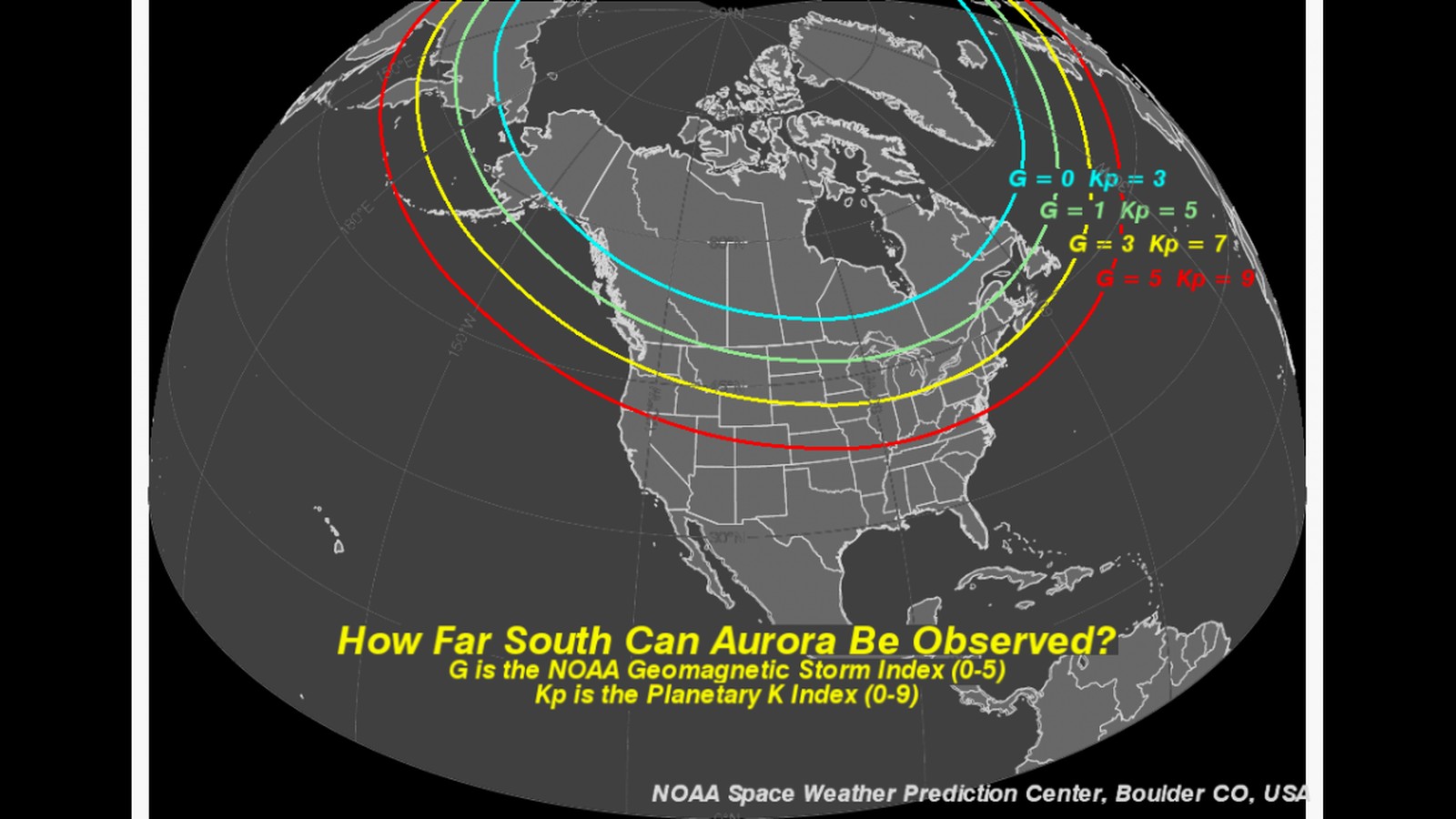
To see the northern lights from the northern edge of the United States, you usually need a Kp of 6 or 7. That is the guidance from NOAA's Space Weather Prediction Center (SWPC), which runs the official U.S. Kp index from 0 to 9. At Kp 8 or 9, SWPC says the aurora may be seen directly overhead in the northern states. Most nights the number sits far lower, and the lights stay over Canada and Alaska.
As of 1:05 PM ET, Monday, Oct 26, 2026, SWPC's latest estimated Kp was 2, for the three-hour block that began 8 AM ET, and its 3-day forecast issued 8:30 AM ET expects Kp no higher than 2 through Oct 28, with no geomagnetic storm.
Quick answers
- What is the Kp index? It is a 0 to 9 measure of how disturbed Earth's magnetic field is, which NOAA SWPC estimates every three hours.
- What Kp do I need to see the aurora from the US? Kp 6 to 7, SWPC says, may bring it to the northern edge of the United States.
- What Kp puts the aurora overhead in the northern states? Kp 8 to 9, according to SWPC.
- What do Kp 3 to 5 look like? SWPC says the aurora grows brighter and more active and moves farther from the poles.
- Is Kp 5 a geomagnetic storm? Yes. Kp 5 is a G1, or minor, storm on NOAA's space weather scales.
- Is the Kp rule exact? No. SWPC says the link between Kp and where the aurora reaches is approximate and based on averages.
- Where do I check Kp tonight? On SWPC's Planetary K index page and its aurora dashboard, both free.
What the Kp index means
Kp is a single number for how much Earth's magnetic field is being shaken, and a higher number pushes the aurora farther from the poles.
SWPC describes the K index as a measure of disturbances in the horizontal part of Earth's magnetic field, scored as a whole number from 0 to 9, with 5 or more marking a geomagnetic storm. Each value covers a three-hour block. The official planetary index, Kp, is the average from 13 observatories between 44 and 60 degrees magnetic latitude, kept by Germany's GFZ research center. The number you see live is SWPC's estimate, built from eight magnetometers from Sitka, Alaska, to Canberra, Australia, and updated every minute. The name comes from the German word Kennziffer, "characteristic digit," and the index dates to 1938.
That matters for aurora watchers because SWPC ties the aurora's reach directly to Kp. In its viewing guide, SWPC says that when the field is active, "the aurora will be brighter and further from the poles."
What Kp you need where you live
The farther south you live, the higher the Kp you need. SWPC sets out four bands.
- Kp 0 to 2: the aurora stays far north, "quite dim in intensity, and not very active."
- Kp 3 to 5: it moves farther from the poles and becomes brighter, with more motion and shapes. SWPC adds that "if you are in the right place, these aurora can be quite pleasing to look at."
- Kp 6 to 7: it becomes quite bright and active, and "it might be possible to see the aurora from the northern edge of the United States."
- Kp 8 to 9: it reaches toward the equator and turns very bright and very active. "At these levels, aurora may be seen directly overhead from the northern states of the USA."
SWPC also gives a rule of thumb in magnetic latitude, which is not the same as the latitude on a map. At Kp 0 the southern edge of the auroral oval sits near 66 degrees magnetic latitude, and it moves about 2 degrees closer to the equator for each step of Kp, reaching about 48 degrees at Kp 9.
You do not need the lights overhead to see them. SWPC says that from a hilltop with a clear view north, a person can see aurora "even when it is 1000 km (600 miles) further north." Its maps, like the one at the top of this page, mark the farthest south the aurora might be seen from, rather than where the aurora itself is.
Kp and the G storm scale
Kp 5 and up is a geomagnetic storm, and NOAA rates storms G1 to G5 by Kp.
NOAA's Space Weather Scales match each G level to a Kp value and name places where aurora has been seen at that level:
- G1, minor (Kp 5): aurora is "commonly visible at high latitudes (northern Michigan and Maine)."
- G2, moderate (Kp 6): seen as low as New York and Idaho.
- G3, strong (Kp 7): seen as low as Illinois and Oregon.
- G4, severe (Kp 8, including 9-): seen as low as Alabama and northern California.
- G5, extreme (Kp 9): seen as low as Florida and southern Texas.
The scales also say how often each level comes. Over an 11-year solar cycle, NOAA counts about 1,700 G1 periods, 600 G2, 200 G3, 100 G4 and 4 G5. So a G1 is common, and a G5 is rare. For what those storms can do to power grids, radio and satellites, and how SWPC's watches, warnings and alerts work, see our geomagnetic storm explainer.
Why a high Kp does not guarantee a show
A high Kp makes the aurora possible where you are. It does not promise you will see it.
SWPC says plainly that the relationship between Kp and auroral latitude is "approximate and represent[s] averages," and that "there will be times when these relationships do not hold up exactly." Kp is also a three-hour number, so a storm can rise and fade inside one block.
The sky has to cooperate too. SWPC's viewing tips list darkness, location and timing alongside activity. Get away from city lights, and expect a full moon to wash it out. The best aurora is usually within an hour or two of midnight, between 10 PM and 2 AM local time, and the skies must be clear of clouds. SWPC adds that the seasons around the spring and fall equinoxes tend to bring larger storms, and that in the far north, summer nights may never get dark enough.
Kp is not the only thing that matters. If you are already under the oval, SWPC says, you can see "very nice auroral displays even with low geomagnetic activity (Kp = 3 or 4)."
How to check Kp tonight
Three free SWPC pages answer the question for tonight.
- Planetary K index: the live bar chart of estimated Kp in three-hour blocks, colored by G level. It is the gauge SWPC uses to decide when to issue geomagnetic alerts and warnings.
- Aurora dashboard: SWPC's one-stop page, still labeled experimental, with tonight's and tomorrow night's aurora maps for North America, the 30-minute forecast and the current Kp. Those night maps use the highest Kp forecast between 6 PM and 6 AM Central time. SWPC says the viewline that once marked the southern edge on those maps was removed in May 2026.
- Aurora 30-minute forecast: a map of where the aurora is likely in the next 30 to 90 minutes, based on the OVATION model and the solar wind measured upstream of Earth.
For the days ahead, SWPC's 3-day forecast lists the expected Kp for each three-hour block. On this site, our space weather page collects every SWPC storm note, such as the G2 storm on Oct 4, the monitor shows the live Kp gauge, and the methodology page explains which agencies we rely on.
Sources
- NOAA Space Weather Prediction Center, Tips on Viewing the Aurora, with the North America aurora and Kp map
- NOAA Space Weather Prediction Center, NOAA Space Weather Scales
- NOAA Space Weather Prediction Center, Planetary K-index and observed Kp data, checked Oct 26, 2026
- NOAA Space Weather Prediction Center, 3-Day Forecast issued 1230 UTC Oct 26, 2026
- NOAA Space Weather Prediction Center, Aurora Dashboard (Experimental), Aurora 30 Minute Forecast and Aurora for Tonight and Tomorrow Night
- NOAA Space Weather Prediction Center, Aurora
Sources: NOAA Space Weather Prediction Center (viewing tips, space weather scales, Planetary K index, 3-day forecast, aurora products). Hero image: NOAA Space Weather Prediction Center, "How Far South Can Aurora Be Observed?" map for North America, padded to 16:9. Status checked 12:40 PM ET, October 26, 2026.