
If you landed here because a headline said "geomagnetic storm warning," the short version is this: the warnings come from one office, the scale has five storm levels, and most alerts are far milder than they sound. Here is how to read them in plain words.
Quick answers
- Is there a geomagnetic storm warning today? Check NOAA's Alerts, Watches and Warnings page, newest first. When I checked at 2:15 PM ET on Saturday, Oct 17, 2026, the geomagnetic level was G0, meaning no storm, and no geomagnetic watch or warning was in effect.
- Who issues them? NOAA's Space Weather Prediction Center (SWPC) in Boulder, Colorado. Not NASA.
- What is the difference between a K4 warning and a G1 storm? A K4 warning means NOAA expects the magnetic field to reach 4 on a 0 to 9 scale, one step below storm level; G1 is the first storm level, which is Kp 5.
- What do G1 to G5 mean for power, GPS and phones? At G1, NOAA lists weak power grid fluctuations; GPS errors and serious grid trouble belong to the upper levels, and NOAA's scale does not list phone calls or texts at any level.
- Will I see the aurora? Only if a storm is strong enough to push the lights toward you; NOAA's aurora dashboard maps tonight's and tomorrow night's viewline.
- Should I do anything to prepare? For most alerts, no; for a rare severe storm, the federal advice is the same kit you would keep for any long power outage.
Is there a geomagnetic storm warning today?
As of 2:15 PM ET on Saturday, Oct 17, 2026, NOAA's space weather scales showed no geomagnetic storm, no solar radiation storm and no radio blackout in progress. That is G0, S0 and R0.
The most recent geomagnetic warning had already run out. NOAA's Space Weather Prediction Center issued a warning for a K-index of 4 at 3:38 PM ET on Friday, Oct 16, valid until 11 PM ET that night, and the index reached 4 at 3:40 PM ET. No geomagnetic watch or warning was in effect when I checked.
NOAA's 3-day forecast, issued at 8:30 AM ET Saturday, said the greatest observed Kp over the previous 24 hours was 4, "below NOAA Scale levels," and that the greatest expected Kp for Oct 17 to Oct 19 was 2.67. Its words: "No G1 (Minor) or greater geomagnetic storms are expected."
Those lines will age. The page that stays current is NOAA's Alerts, Watches and Warnings list. Every message carries its issue time in UTC, which runs four hours ahead of Eastern time during daylight saving time and five hours ahead the rest of the year. The bar at the top of SWPC's pages shows the current R, S and G levels, and the 3-day forecast gives the expected Kp in three-hour blocks.
Who issues the warnings (NOAA SWPC, not NASA)
Space weather watches, warnings and alerts for the United States come from NOAA's Space Weather Prediction Center, part of the National Weather Service. It is the same family of forecasters who issue hurricane and tornado warnings, working the Sun instead of the sky.
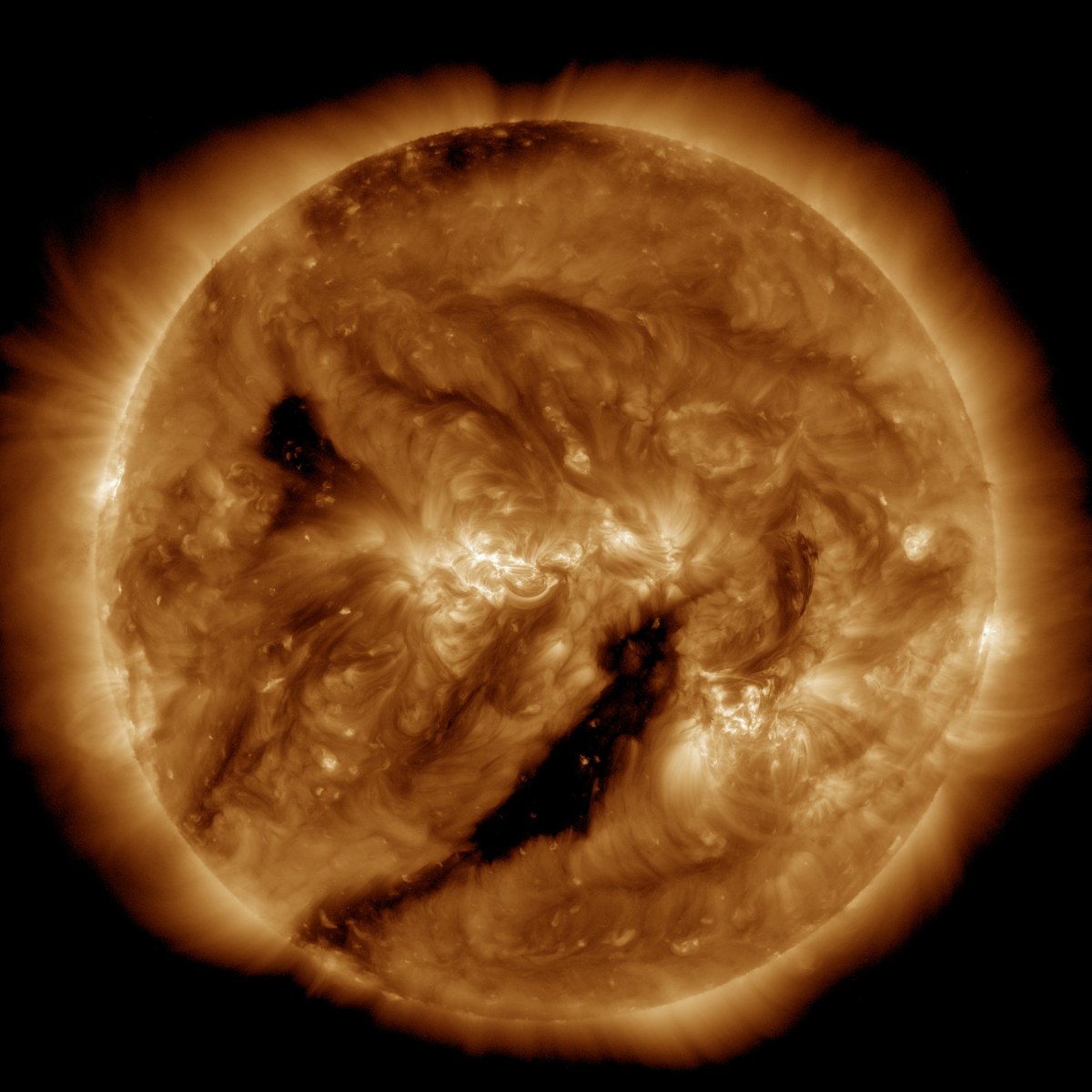
NASA studies the Sun and flies many of the spacecraft that watch it, including the Solar Dynamics Observatory that took the picture at the top of this page. But NASA does not issue the public warnings. When a post says "NASA warns of a solar storm," the official word, if there is one, will be on SWPC's site.
Watch, warning, alert: what each one means
SWPC uses three words, and they line up with how close the event is.
A watch is the long view. SWPC says a geomagnetic storm watch is driven by the forecast of an impending storm and can cover the current day through the third day, up to 72 hours ahead. Watches are always given as a G level, such as "G1 predicted," and SWPC says they carry "a lower degree of confidence both in intensity and in timing" than a warning. SWPC says the lead time often comes down to how fast the cloud of solar material behind the storm, a coronal mass ejection, is moving. Those clouds typically take several days to reach Earth, though SWPC has seen trips of 16 to 18 hours.
A warning is the near view. SWPC says geomagnetic warnings are driven by measurements of the solar wind taken upstream of Earth, carry "a higher degree of confidence in both timing and intensity," and "are generally only issued minutes to a couple of hours in advance." Warnings are given as a K-index level: 4, 5, 6, or 7 or greater.
An alert means it is happening. In SWPC's words, "an Alert is a characterization of what is occurring now," triggered when ground magnetometers show a level has been reached. Alerts go out when the K-index reaches 4, 5, 6, 7, 8 or 9.
Two practical notes. A watch can be cancelled or replaced as the forecast changes, and that happened on Oct 11, when SWPC cancelled a G2 watch and later that day issued a G1 watch. And a "K4 warning" or "K4 alert" is not a storm watch at all. It sits one step below the storm scale.
The K-index and the G1 to G5 scale
The K-index measures how much Earth's magnetic field is being shaken over a three-hour window, from 0 to 9. SWPC describes 1 as calm and "5 or more" as a geomagnetic storm. The planetary version, Kp, blends readings from observatories around the world, and it is the number on NOAA's gauges.
NOAA's storm scale starts where storms start, at Kp 5. Here is each level in SWPC's own terms, with SWPC's average frequency over an 11-year solar cycle.
- G1, Minor (Kp 5): weak power grid fluctuations can occur; minor impact on satellite operations possible; aurora is commonly visible at high latitudes such as northern Michigan and Maine. About 1,700 per cycle (900 days per cycle).
- G2, Moderate (Kp 6): high-latitude power systems may see voltage alarms, and long storms may cause transformer damage; HF radio can fade at higher latitudes; aurora has been seen as low as New York and Idaho. About 600 per cycle (360 days per cycle).
- G3, Strong (Kp 7): voltage corrections may be required and some protection devices may give false alarms; satellite navigation and HF radio may be intermittent; aurora has been seen as low as Illinois and Oregon. About 200 per cycle (130 days per cycle).
- G4, Severe (Kp 8, including a 9-): possible widespread voltage control problems, with some protective systems tripping key assets off the grid; satellite navigation degraded for hours; aurora has been seen as low as Alabama and northern California. About 100 per cycle (60 days per cycle).
- G5, Extreme (Kp 9): widespread voltage control problems, and some grids may collapse or black out; transformers may be damaged; satellite navigation may be degraded for days; aurora has been seen as low as Florida and southern Texas. About 4 per cycle (4 days per cycle).
Read the bottom of that list first. A G1 is common, the kind of thing that comes and goes many times a year when the Sun is busy. A G5 comes about four times in an 11-year cycle. The jump between them is the reason the scale exists.
A K4 warning, the kind SWPC kept running from the evening of Oct 12 to the morning of Oct 14 ET and issued again on Oct 16, sits below all of it. SWPC's K4 messages list impacts mainly "poleward of 65 degrees Geomagnetic Latitude": weak power grid fluctuations, and aurora that "may be visible at high latitudes such as Canada and Alaska."
What a storm can actually affect
Power. SWPC's general description is that geomagnetic storms "create induced currents on power grid elements and long-distance pipelines." At G1 and G2 the scale lists weak fluctuations and voltage alarms, with possible transformer damage in long G2 storms. At G4 and G5 the scale talks about protective systems tripping and, at the very top, blackouts.
GPS. Storms disturb the upper atmosphere that GPS signals pass through. SWPC says that in calm conditions a single-frequency GPS receiver can be accurate to a meter or less, and that during a severe storm the errors "can increase to tens of meters or more." On the storm scale, satellite navigation trouble first appears at G3 as "intermittent," becomes "degraded for hours" at G4, and "may be degraded for days" at G5.
Phones. SWPC notes that GPS receivers are now "in nearly every cell phone," so the location on your phone is the piece that can drift in a strong storm. NOAA's storm scale does not list phone calls, texts or mobile data among the effects at any level. The radio it does name is HF, high-frequency shortwave radio. The broader worry is indirect: the federal preparedness site Ready.gov notes that a space weather power outage can take telephone and communications systems down with it.
Satellites. From G1 up, SWPC lists effects on satellite operations, from "minor impact" at G1 to surface charging, drag and tracking problems in bigger storms.
Getting ready. For a K4 warning or a G1, the effects SWPC lists are weak grid fluctuations and aurora in the north, and there is nothing for a household to do. For the rare severe storm, the federal preparedness site Ready.gov gives the same advice it gives for any long power outage: build an emergency kit, make a family communications plan, keep extra batteries or chargers for your phone and laptop, and keep your car's gas tank at least half full, since gas pumps run on electricity. During a severe event it asks people to keep electricity use low and follow Emergency Alert System instructions.
Will you see the aurora?
Maybe, if the storm is strong enough and your sky is dark. The scale above gives the rough line: northern Michigan and Maine at G1, New York and Idaho at G2, down to Florida and southern Texas only at G5.
For tonight, use SWPC's aurora dashboard, which maps a viewline for tonight and tomorrow night, and the 30-minute aurora forecast, which looks 30 to 90 minutes ahead. SWPC says the aurora "is not visible during daylight hours," that it can often be seen somewhere on Earth from just after sunset or just before sunrise, and that it does not need to be overhead: it "can be observed from as much as a 1000 km away when the aurora is bright and if conditions are right."
On the dashboard's key, Kp 3 is labeled quiet aurora, and NOAA expects Kp no higher than 2.67 through Oct 19. If you are hoping for lights this weekend, the odds favor the far north.
How Doom Signals tracks space weather
Our space weather page collects every space weather note on the board, newest first, built on SWPC's scales, alerts and forecasts, with the official sources we watch listed at the top. The geomagnetic gauge on our live HUD reads SWPC's planetary K-index.
When a warning runs long, we write it down. On Oct 14 we noted that SWPC kept a K4 geomagnetic warning running for a second day, with no storm in progress. That is the shape of most space weather news: a field that is restless, not stormy. When a real storm comes, the level, the time and the source go on the board, in SWPC's words.
The calm reading is also the honest one. Most alerts are small, and the scale tells you exactly how small. The rare big storm is real too, which is why the warnings exist, and why the place to check is NOAA, not a screenshot.
Sources
- NOAA SWPC, Alerts, Watches and Warnings, including WARNING WARK04 serial 5436 and ALERT ALTK04 serial 2691, Oct 16, 2026
- NOAA SWPC, NOAA Space Weather Scales
- NOAA SWPC, 3-Day Forecast, issued 8:30 AM ET Oct 17, 2026
- NOAA SWPC, Planetary K-index
- NOAA SWPC, Subscription Services: Geomagnetic Warnings, Alerts, and Watches
- NOAA SWPC, Geomagnetic Storms
- NOAA SWPC, Space Weather and GPS Systems
- NOAA SWPC, Aurora Dashboard and Aurora: 30 Minute Forecast
- Ready.gov (U.S. Department of Homeland Security), Space Weather
- Hero image: NASA Solar Dynamics Observatory, AIA 193 angstrom image, 1:57 PM ET Oct 17, 2026
Sources: NOAA Space Weather Prediction Center (alerts, watches and warnings; NOAA Space Weather Scales; 3-day forecast; planetary K-index; aurora dashboard); Ready.gov. Hero image: Courtesy of NASA/SDO and the AIA, EVE, and HMI science teams. Status checked 2:15 PM ET, October 17, 2026.