
official data (NOAA / NWS Space Weather Prediction Center: Forecast Discussion and 3-Day Forecast 1230 UTC Oct 8 2026 · WATCH WATA30 Serial 283 · ALERT ALTEF3 Serial 3752 · SUMMARY SUMXM5 Serial 327) · ECDO-lane monitor
NOAA still expects a G2 storm Friday morning, and a second solar blast may reach Earth Saturday night

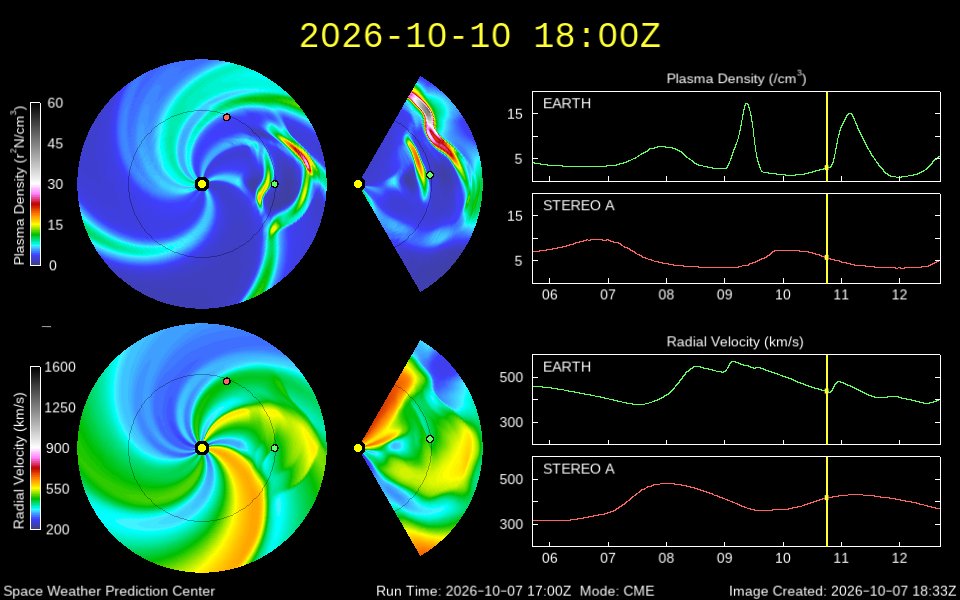
The Sun isn’t done with this week. NOAA’s space weather forecasters still expect the CME launched on Oct 6 to reach Earth early Friday, Oct 9, with G1 to G2 storming and the strongest stretch forecast for roughly 5 to 8 AM Eastern. That is a moderate storm, not a severe one. Meanwhile the same tangled sunspot group, Region 4549, threw off a second CME on Oct 7, and NOAA’s first modeling says part of it is aimed at Earth, arriving Saturday night into Sunday Eastern time. There is no watch for that one yet.
Key facts
- Watch WATA30, Serial 283
- Issued 1633 UTC (12:33 PM EDT) Oct 6 · Oct 9 G2 (Moderate) · CME that left the Sun on Oct 6 after an M1.4 flare from Region 4549 · still the watch in effect
- Timing (3-Day Forecast, 1230 UTC Oct 8)
- Kp 5.00 (G1) for 0300 to 0600 UTC Oct 9 (11 PM EDT Thu to 2 AM EDT Fri) · Kp 5.67 (G2) for 0900 to 1200 UTC Oct 9 (5 to 8 AM EDT Fri) · unsettled to active through Oct 10 under a coronal hole stream
- Not severe
- The watch is G2 (Moderate) on NOAA’s 1 to 5 scale. Nothing official points above G2 this week
- Second CME
- Followed a C7.9 flare from Region 4549 at 1317 UTC Oct 7; seen off the northwest limb in SOHO/LASCO C2 imagery from 1500 UTC. SWPC modeling shows an Earth-directed component arriving early on the Oct 11 UTC day (Saturday night into Sunday ET). No watch issued for it yet
- Today’s flare
- M6.7 at 1548 UTC (11:48 AM EDT) Oct 8, location N12W20, near Region 4549’s reported position · R2 (Moderate) radio blackout on the sunlit side (SWPC SUMXM5 Serial 327) · SWPC had not reported a CME from it as of 12:15 PM EDT
- Region 4549
- N10W22, Dki, beta-gamma-delta · produced most of the activity · 40% chance of M-class flares (R1 to R2) each day through Oct 10, 5% for R3 or greater
All facts (8)
- Radiation
- >2 MeV electrons at geosynchronous orbit above the 1,000 pfu alert level since 1830 UTC Oct 5 (ALTEF3 Serial 3752) · peak 11,911 pfu at 1645 UTC Oct 7 · expected high through Oct 9 · 10% chance of an S1 proton storm through Oct 10
- Right now
- No geomagnetic storm in the 24 hours to 1505 UTC Oct 8; greatest observed Kp 3 · SWPC: G2-level storms are likely in the next 24 hours
G1-G2 (Minor-Moderate) geomagnetic storms are likely on 09 Oct with the arrival of the 06 Oct CME events.
NOAA / NWS SWPC Forecast Discussion, issued 2026 Oct 08 1230 UTC
Note
NOAA’s Space Weather Prediction Center issued Watch WATA30, Serial 283, at 12:33 PM EDT on Oct 6, after sunspot Region 4549 produced an M1.4 flare and a halo coronal mass ejection with an Earth-directed part. It calls for a G2 (Moderate) geomagnetic storm on Oct 9 and is still the watch in effect. SWPC’s Forecast Discussion issued at 1230 UTC Oct 8 keeps that outlook: G1 to G2 storms are likely on Oct 9 with the arrival of the Oct 6 CME events. The 3-Day Forecast puts Kp at 5.00 (G1) from 0300 to 0600 UTC and 5.67 (G2) from 0900 to 1200 UTC on Oct 9. In Eastern time that is roughly 11 PM Thursday to 2 AM Friday, then about 5 to 8 AM Friday. A coronal hole high-speed stream is expected to follow, keeping the field unsettled to active through Oct 10. This is a moderate storm watch, not a severe storm forecast.
On Oct 7, Region 4549 produced a C7.9 flare at 1317 UTC, the largest of the day, followed by a CME seen off the Sun’s northwest edge in SOHO/LASCO C2 coronagraph images from 1500 UTC. SWPC says its modeling of that CME indicates an Earth-directed component arriving early on the Oct 11 UTC day, which is Saturday night into Sunday in the eastern U.S. SWPC has not issued a storm watch for that date. Region 4549 sits at N10W22 and is classed beta-gamma-delta, with opposite magnetic polarities crowded together, the kind of group forecasters watch for stronger flares. SWPC puts the chance of M-class flares at 40% per day through Oct 10 and of R3 (strong) or greater at 5%.
At 11:48 AM EDT Thursday an M6.7 flare peaked at N12W20, close to Region 4549’s reported position, and caused an R2 (Moderate) radio blackout, a limited loss of high-frequency radio on the sunlit side of Earth for tens of minutes. SWPC had not said whether it launched a CME as of 12:15 PM EDT.
High-energy electrons above 2 MeV at geosynchronous orbit, where many communications and weather satellites sit, crossed NOAA’s 1,000 pfu alert level at 1830 UTC Oct 5 and have stayed above it, peaking at 11,911 pfu at 1645 UTC Oct 7. SWPC expects high levels through Oct 9, easing after the CME arrives. Protons are at background, with a 10% chance of an S1 radiation storm through Oct 10.
Back-to-back CMEs from one complex region are the setup forecasters watch most closely, because a second cloud can arrive into a field already disturbed by the first. Arrival times usually carry an uncertainty of several hours either way, and the Oct 11 timing is first-pass modeling only. Nothing official says this week will go beyond G2.
Why it matters
On NOAA’s own scale a G2 storm is moderate: high-latitude power systems can see voltage alarms, satellite operators may need to adjust, and aurora can reach as far south as New York to Wisconsin to Washington state on a clear night. The bigger signal is the sunspot itself. A delta region that keeps firing, now with an M6.7 flare on Thursday, is how a quiet week turns into a busy one.
Sources
- NOAA / NWS SWPC: Forecast Discussion (issued 2026 Oct 08 1230 UTC; updates)
- NOAA / NWS SWPC: 3-Day Forecast (issued 2026 Oct 08 1230 UTC; updates)
- NOAA / NWS SWPC: alerts, watches and warnings (WATA30 Serial 283, ALTEF3 Serial 3752, SUMXM5 Serial 327)
- NOAA / NWS SWPC: Geophysical Alert Message (issued 2026 Oct 08 1505 UTC)
- NOAA Space Weather Scales
- Earlier: SWPC G2 reached Oct 4 as coronal-hole stream lingers
- Hero image: NASA/SDO and the AIA science team (AIA 131 · 15:43 UTC Oct 8 2026)
- Official graphic: NOAA SWPC WSA-Enlil
Primary + secondary attribution as listed.
More: Space weather
Doom Signals desk · About · Contact · Corrections. Spotted an error? Write the desk; fixes go on the public log.