
peer-reviewed primary (Nature Communications) · PubMed abstract · Folio hypothesis lane (magnetic / radiation-belt weirdness; NOT an ECDO-as-proof claim)
South Atlantic Anomaly radiation briefly spills past its usual edges, Nature paper says
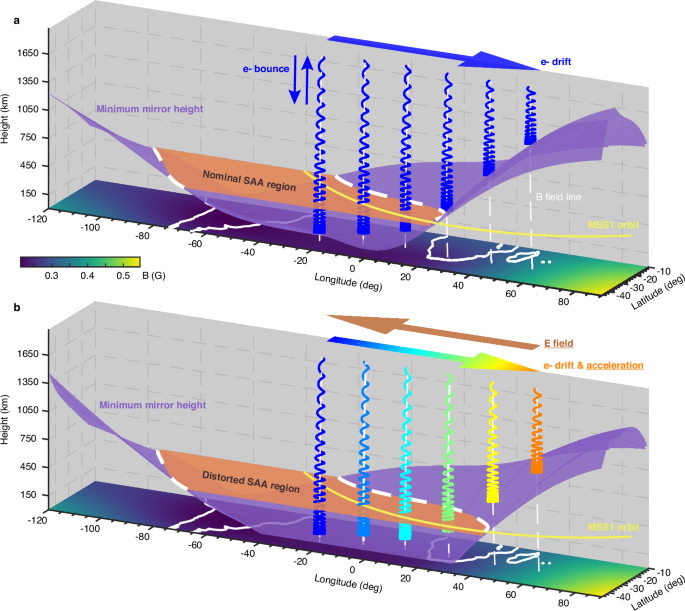
A Nature Communications study using Macau Science Satellite-1 reports transient distortions of South Atlantic Anomaly radiation environments — energetic electrons appearing outside the traditional SAA radiation boundary, attached to or detached from its edge — driven by large-scale electric-field perturbations that lower electron mirror heights, with ultra-low-frequency waves as a further modulator.
Key facts
- Primary
- Nature Communications — “Transient distortions of the South Atlantic Anomaly radiation environments driven by electric fields.” DOI: 10.1038/s41467-026-74984-z. PubMed PMID: 42399622.
- Platform
- Macau Science Satellite-1 (MSS1) — LEO ~450–500 km, 41° inclination (paper Methods / abstract context)
- Observation stamp
- Transient distortions: enhanced energetic-electron fluxes outside the traditional SAA radiation region — either attached to or detached from its boundary
- Mechanism (authors)
- Large-scale electric-field perturbations adiabatically alter electron mirror heights; ultra-low-frequency waves can further modulate the distortions
- Implication (authors)
- Findings “extend the electron radiation risks beyond the expected boundaries of the SAA radiation environments”
- Context (authors)
- Inner belt once treated as stable; now understood to show significant variability; LEO radiation hazards strongest in SAA
- Event windows named in figures (2024 obs)
- Paper figures discuss events including Apr 9 / Apr 10 2024 (vertical stripe / zebra), Jul 15–16 2024 (recurrent stripes), Sep 24–25 2024 (contiguous expansion) — observational case studies, not a live 2026 storm claim
- Desk framing
- Official peer-reviewed radiation-belt physics. Distinct from boarded esa-swarm-south-atlantic-anomaly-2026 (magnetic-field / Swarm geography). ECDO stays hypothesis and OFF weekly-board framing — this card is SAA radiation-boundary variability, not ECDO-as-proof.
- Live
- No live gauge invented. Later MSS1 / NOAA SEM products → HUD. Concurrent color only: INPE SAA symposium Sep 21–23 2026 in São José dos Campos (conference, not a new flux meter).
extend the electron radiation risks beyond the expected boundaries of the SAA radiation environments
Nature Communications abstract — Transient distortions of the South Atlantic Anomaly radiation environments driven by electric fields (DOI 10.1038/s41467-026-74984-z)
Note
Nature Communications reports that Macau Science Satellite-1 saw transient distortions of South Atlantic Anomaly radiation environments: energetic electrons showing up outside the traditional SAA radiation region, sometimes attached to the edge and sometimes detached from it. Authors point to large-scale electric-field perturbations that lower electron mirror heights, with ultra-low-frequency waves as a further modulator — and say the findings extend electron radiation risk beyond the maps’ usual SAA boundary.
The soft spot in the magnetic shield can smear. The spacecraft-scale risk: radiation where quiet-zone maps said the belt should be quieter. Figure windows named in the paper (April, July, and September 2024 case studies) are observational stamps, not a live 2026 storm claim. No invented live flux meter.
Attribution: Nature Communications DOI 10.1038/s41467-026-74984-z via PubMed PMID 42399622; Zenodo MSS1 dataset. Distinct from the boarded ESA Swarm magnetic-weakening SAA card — this is the electron/spillover twin. ECDO stays hypothesis only; this peer-reviewed radiation-belt physics is not proof of ECDO. Live later MSS1 / NOAA SEM products → HUD.
Why it matters
Nature Communications stamps South Atlantic Anomaly radiation-belt spillover in peer-reviewed physics — not a prophecy. Stack beside the boarded ESA Swarm SAA card as the electron/spillover twin, not a duplicate magnetic-weakening note. ECDO remains a tracked hypothesis only — this paper does not prove it.
Sources
Primary + secondary attribution as listed. Live values go to the HUD / source product.