
peer-reviewed primary (PNAS) · institutional press (University of Basel IPAS / University of Tartu) · secondary carry (Archaeology News Online Mag)
Black Death was only the opening wave — plague returned for 350+ years, ancient DNA shows
A PNAS study reconstructing plague genomes from European graves shows the Black Death of 1347–1353 did not end the pandemic — Yersinia pestis kept returning in recurring waves for more than three and a half centuries, seeding new reservoirs and riding the same roads as armies, refugees, and traders.
Key facts
- Primary
- Keller, M., Guellil, M., Slavin, P., et al. — Proc. Natl. Acad. Sci. U.S.A. 123(37), e2534899123. DOI: 10.1073/pnas.2534899123. Title: “A refined phylochronology of the second plague pandemic in Western Eurasia.”
- New genomes
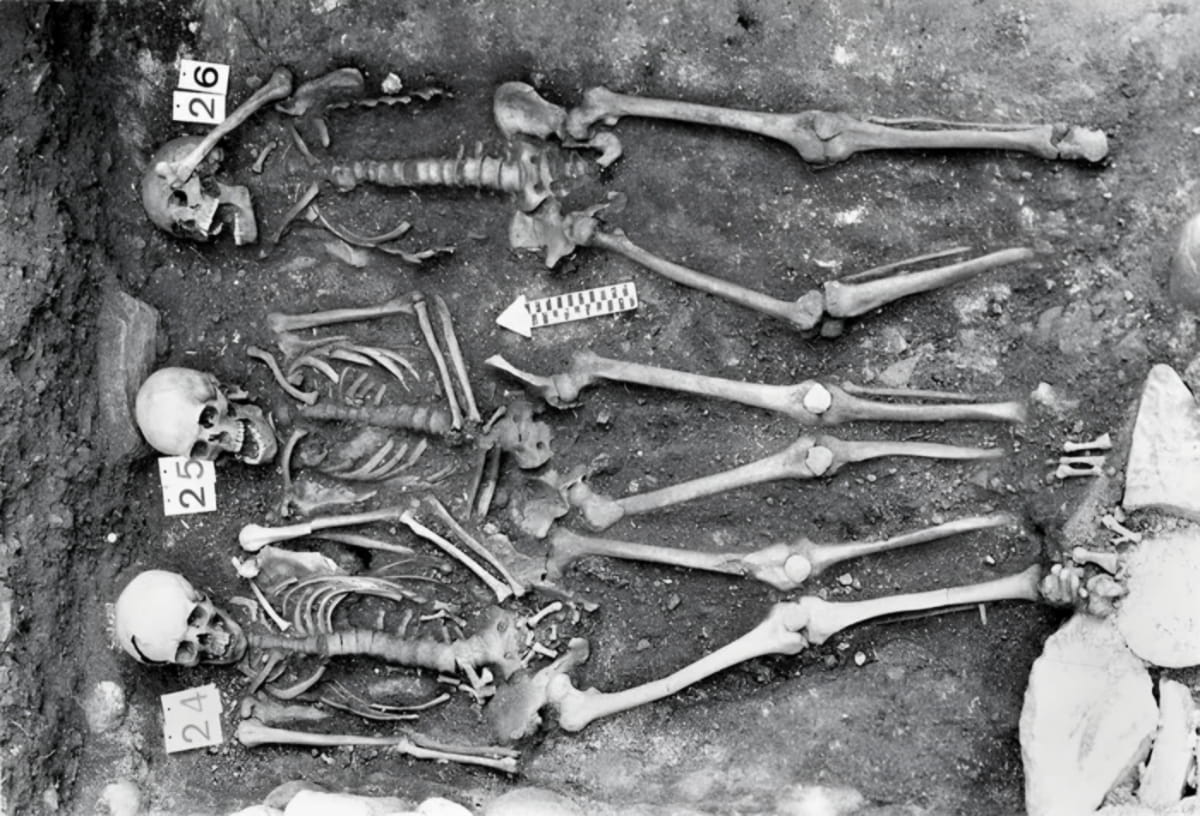
- 26 Yersinia pestis genomes reconstructed from 11 archaeological sites (Estonia, Russia, England, Netherlands, Switzerland), spanning 1349–1710 (IPAS Basel / Archaeology Mag).
- Reassessment
- 64 previously published + 11 newly sequenced genomes reassessed with improved dates; first systematic attempt to link nearly all available 14th–18th c. plague genomes to documented outbreaks (75 genomes associated — Archaeology Mag / IPAS).
- Method
- PhIRM — Phylogenetically Informed Radiocarbon Modeling — narrows century-wide radiocarbon intervals by combining RC dates with phylogenetic position (Keller via IPAS).
- Pattern (authors / press)
- Plague did not persist in one single post–Black Death reservoir; it repeatedly resurfaced in different regions, seeding multiple new reservoirs.
- Expansion stamp
- Major lineage expansion ~1450–1500 — bacterium diversified into three major branches; possible new wild-rodent reservoirs (IPAS). Climate color: Great Renaissance Drought speculated as a factor.
- Conflict links
- Genetic evidence tied to Thirty Years’ War (1618–1648) and Great Northern War (~1700–1721); Domat/Ems (Grisons) multiple burials / young men / military equipment → Bündner Wirren / Thirty Years’ War plague; Tallinn 1710 siege — civilians + Swedish + Russian troops.
- Estonia color
- Repeated introductions from late 14th c.; previously unknown lineages in urban and rural settings (Tambets via IPAS).
- Modern frame (authors)
- Plague no longer a major European public-health threat; Y. pestis still causes yearly casualties where it survives in rodent reservoirs in Asia, Africa, and the Americas — long-view epidemic dynamics, not a claim of a new European Black Death now.
The Black Death was the opening wave — not the last chapter.
Desk reading of PNAS / University of Basel IPAS (Sep 17, 2026) and Archaeology Mag (Sep 19, 2026)
Note
On September 17–19, university and archaeology press carried a PNAS study that reconstructs the Second Plague Pandemic after the Black Death. Researchers led by Marcel Keller report 26 new Yersinia pestis genomes from 11 European archaeological sites (1349–1710), then use a new dating method — Phylogenetically Informed Radiocarbon Modeling — to tighten radiocarbon windows and tentatively link 75 genomes to historically recorded outbreaks. The pattern they describe is not one leftover reservoir after 1347–1353, but repeated resurfacing across Europe, a major lineage split around 1450–1500, and genetic ties to conflict corridors including the Thirty Years’ War and the Great Northern War. Plague still exists in rodent reservoirs outside Europe; the paper does not claim a new European pandemic today.
Attribution: PNAS DOI 10.1073/pnas.2534899123; University of Basel IPAS (17 Sep 2026); Archaeology Mag (19 Sep 2026). Desk did not open full PNAS HTML (Cloudflare); numbers follow the consistent institutional/secondary stamps.
Why it matters
The Black Death gets remembered as one apocalypse. This paper’s stamp is colder: the bacterium kept coming back for generations — new branches, new animal reservoirs, armies and refugees on the same roads — and scientists can finally pin many of those genomes to named historical outbreaks. That is a 350-year panel, not a one-summer scare.
Sources
Primary + secondary attribution as listed. Live values go to the HUD / source product.